Unlock Financial Success with CalAIM: Budget Estimator Tool for CBOs

The CalAIM Budget Estimator Tool helps CBOs navigate the financial complexities of contracting under CalAIM. It offers an Excel-based template with built-in assumptions, cost input fields, revenue customization, and a summary tab. The tool supports informed decision-making, negotiation power, and sustainability, empowering organizations to enhance care and expand services.

Introduction

Navigating the financial complexities of contracting under the California Advancing and Innovating Medi-Cal (CalAIM) initiative can be challenging for community-based organizations (CBOs). With new Medi-Cal benefits such as Enhanced Care Management and Community Supports, understanding potential revenue and expenses is crucial. This is where the CalAIM Budget Estimator Tool comes in, offering a robust template to help CBOs project financial viability and ensure their mission’s sustainability.

Understanding the CalAIM Budget Estimator Tool

CalAIM Budget Estimator Tool: The CalAIM Budget Estimator Tool is an Excel-based template designed to help organizations estimate costs and potential revenue from providing Medi-Cal Enhanced Care Management and selected Community Support Services. These services include housing-related services and medically tailored meals.

Key Features

  • Built-in Assumptions: The tool incorporates assumptions about payment structures for these services, as outlined in the California Department of Health Care Services CALAIM Enhanced Care Management Policy Guide and Community Supports Policy Guide.
  • Cost Input: Users can enter organization-specific expenses such as staffing costs and other direct and indirect costs.
  • Revenue Customization: It includes generic rate ranges and areas for customizing expected revenue sources to calculate the program margin (ratio of revenue to expenses).
  • Summary Tab: A summary tab displays the projected margin by program year, helping users understand if their assumptions lead to a fiscally viable program.

The Importance of Financial Viability for CBOs

For CBOs, financial viability is paramount. The adage “No margin, no mission” rings true as these organizations aim to enhance services for individuals with complex health and social needs. The CalAIM Budget Estimator Tool enables organizations to model various scenarios for their programs, supporting meaningful feasibility discussions with financial officers and other decision-makers.

How the CalAIM Budget Estimator Tool Supports CBOs

The CalAIM Budget Estimator Tool is designed to facilitate informed discussions about future programming and the financial feasibility of providing new Medi-Cal services. Here’s how it supports CBOs:

  • Modeling Various Scenarios: The tool allows organizations to create multiple financial scenarios, enabling a comprehensive understanding of different potential outcomes.
  • Justifying Rate Requests: By organizing and highlighting critical financial information, the tool helps CBOs justify rate requests to MCOs during contract negotiations.
  • Enhancing Financial Confidence: With detailed projections, CBOs can confidently navigate the financial aspects of contracting with MCOs.

Step-by-Step Guide to Using the CalAIM Budget Estimator Tool

Step 1: Download the Tool

Step 2: Enter Costs

  • Input your organization-specific expenses, including staffing costs and other direct and indirect costs.

Step 3: Customize Revenue Sources

  • Use the tool to enter expected revenue sources. Customize the rates to reflect realistic projections for your organization.

Step 4: Review Summary Tab

  • Examine the summary tab to view the projected margin by program year. This will help you understand the financial viability of your program.

Benefits of Using the CalAIM Budget Estimator Tool

Informed Decision-Making: The tool provides comprehensive data to support strategic financial decisions. Enhanced Negotiation Power: With detailed financial projections, CBOs can negotiate better rates with MCOs. Sustainability: Ensuring financial viability helps CBOs sustain their mission and expand services under CalAIM.

Frequently Asked Questions

What is the CalAIM Budget Estimator Tool? The CalAIM Budget Estimator Tool is an Excel-based template designed to help organizations estimate costs and potential revenue from providing Medi-Cal Enhanced Care Management and selected Community Support Services.

How does the tool support CBOs in contracting with MCOs? The tool enables CBOs to model various financial scenarios, justify rate requests during negotiations, and make informed decisions about program viability.

What are the key features of the CalAIM Budget Estimator Tool? Key features include built-in assumptions, cost input fields, revenue customization, and a summary tab displaying projected margins.

Can the tool be customized for specific organizational needs? Yes, users can customize expense inputs and revenue projections to reflect their specific organizational needs.

How do I get started with the CalAIM Budget Estimator Tool? Download the tool, enter your organization-specific costs, customize revenue sources, and review the summary tab to understand financial projections.

Why is financial viability important for CBOs? Financial viability ensures that CBOs can sustain their mission and expand services, ultimately enhancing care for individuals with complex health and social needs.

Conclusion

The CalAIM Budget Estimator Tool is an invaluable resource for CBOs looking to contract with managed care organizations under CalAIM. By providing detailed financial projections, the tool empowers organizations to make informed decisions, justify rate requests, and ensure the sustainability of their mission. Download the tool today and take the first step towards financial success and enhanced service offerings.
Mindfulness-Based Interventions: Enhancing Resilience in Healthcare Settings

Mindfulness-based meditation has emerged as a recommended intervention to address these challenges. By cultivating resilience and providing tools to cope with stress, mindfulness interventions can help healthcare professionals navigate the demanding and vulnerable nature of their work.

Within the healthcare sector, a collective sense of cognitive dissonance, burnout, and distress can have detrimental effects on both the well-being of healthcare professionals and the quality of patient care. Mindfulness-based meditation has emerged as a recommended intervention to address these challenges. By cultivating resilience and providing tools to cope with stress, mindfulness interventions can help healthcare professionals navigate the demanding and vulnerable nature of their work. This article explores the impact of low staff morale in healthcare, proposes a plan of action to address the issue, and highlights the potential benefits of implementing mindfulness-based interventions.

Establishing the Problem/Situation

Low staff morale within healthcare environments undermines the essence of “care” in healthcare, resulting in adverse consequences for both the institution and its stakeholders. The prevalence of medical errors, high turnover rates, compliance concerns, and safety implications are just some of the outcomes associated with low staff morale. To mitigate these issues, an enterprise-wide program aimed at enhancing resilience, stress management, and empathy among healthcare professionals presents a promising solution. Strengthening these constructs can yield significant clinical, financial, and operational benefits.

Proposed Plan of Action

To address the problem effectively, management should take the following steps:

  1. Define and identify moral distress: Clearly articulate the concept of moral distress and recognize its impact on healthcare professionals’ well-being and job performance.
  2. Assess stakeholder impact: Consider the effects of low staff morale on patients, internal staff, external stakeholders, and the overall reputation of the healthcare institution.
  3. Evaluate the bottom-line impact: Quantify the financial repercussions of low staff morale, such as increased malpractice costs, turnover expenses, reduced patient volume, and fines/penalties from regulatory authorities.
  4. Formulate a strategy: Develop a comprehensive strategy that targets employees’ intrinsic constructs and promotes resilience. This strategy should provide cognitive tools, such as mindfulness-based interventions, to help employees cope with stress in their work environment.

Mindfulness-based meditation interventions have demonstrated effectiveness in promoting physician well-being, resilience, and personal achievement. However, it is crucial to tailor these interventions to the unique culture and management commitment of each healthcare organization.

By implementing mindfulness-based interventions, healthcare institutions can expect the following outcomes:

  • Improved well-being and resilience among healthcare professionals
  • Enhanced quality of life and increased positive affect for employees
  • Development of intrinsic coping mechanisms and stress reduction
  • Positive spill-over effects into employees’ personal lives

Conclusions and Recommendations

In healthcare delivery settings, collective cognitive dissonance, burnout, and distress undermine the quality of patient care and the well-being of healthcare professionals. Mindfulness-based interventions offer a promising approach to address these challenges comprehensively. The neurological mechanisms underlying mindfulness meditation promote resilience, improve quality of life, increase positive affect, and develop intrinsic coping mechanisms. By providing evidence-based workplace wellness interventions, rooted in mindfulness, healthcare institutions can not only foster a positive work environment but also improve employees’ personal lives.

Implementing mindfulness-based interventions requires commitment from management and a willingness to challenge the status quo. By prioritizing employee well-being and providing the necessary resources, healthcare institutions can create a culture that supports resilience, reduces stress, and enhances the delivery of compassionate care.

References

Baer, R. (2015). Ethics, Values, Virtues, and Character Strengths in Mindfulness-Based Interventions: a Psychological Science Perspective. Mindfulness, 6(4), 956-969.

De Clercq, D., Bouckenooghe, D., Raja, U., & Matsyborska, G. (2014). Unpacking the Goal Congruence–Organizational Deviance Relationship: The Roles of Work Engagement and Emotional Intelligence. Journal of Business Ethics, 124(4), 695-711.

Robbins, A. (2015). Doctors Throwing Fits. Retrieved from http://www.slate.com/articles/health_and_science/medical_examiner/2017/05/willie_parker_helped_me_find_the_moral_language_i_was_missing.html

Schroeder, D. A., Stephens, E., Colgan, D., Hunsinger, M., Rubin, D., & Christopher, M. S. (2016). A Brief Mindfulness-Based Intervention for Primary Care Physicians: A Pilot Randomized Controlled Trial. American Journal of Lifestyle Medicine.

Shapiro, S. L., Astin, J. A., Bishop, S. R., & Cordova, M. (2005). Mindfulness-based stress reduction for health care professionals: Results from a randomized trial. International Journal of Stress Management, 12(2), 164-176.

Maryland Physicians Care (MPC) Provider Relations Representatives Maryland Physicians Care

Maryland Physicians Care (MPC) Provider Relations Representatives Maryland Physicians Care

Maryland Physicians Care (MPC) Provider Relations Representatives Maryland Physicians Care

MPC providers have designated Provider Relations Representatives based on the practice/group location. This specialist will be your primary contact with MPC and will keep you updated on any policy changes. To find your Provider Relations Representative, select a territory for the list below.

Phone: 1-800-953-8854 (follow prompts to PR dept.)
Fax: 866-333-8024

Download the Territory List

MPC Provider Relations Representatives

CAQH Index Benchmarks & Time Spent on Administrative Work in Healthcare

The CAQH Index benchmarks adoption, volume, cost savings opportunities and spend for transactions along the administrative workflow. The following metrics help measure progress towards an automated workflow. By tracking progress, the industry can more easily identify barriers that may be delaying automation and administrative simplification and focus efforts on them.

2021 CAQH INDEX®

The CAQH Index benchmarks adoption, volume, cost savings opportunities and spend for transactions along the administrative workflow.  

The CAQH Index benchmarks adoption, volume, cost savings opportunities and spend for transactions along the administrative workflow. The following metrics help measure progress towards an automated workflow. By tracking progress, the industry can more easily identify barriers that may be delaying automation and administrative simplification and focus efforts on them.

ADMINISTRATIVE WORKFLOW


While COVID-19 touched all healthcare professionals, the pandemic impacted the medical and dental administrative workflows differently.

The following touches on MEDICAL and DENTAL.

Utilization

Policies developed by federal and state entities to curb the spread of COVID-19 resulted in lower utilization for both industries as people delayed, or went without, medical care. In general, lower utilization led to lower transaction volumes. Smaller dental practices were hit particularly hard by lower utilization as many offices were forced to close for several months or close permanently.

Spend

Although electronic adoption and volume increased for both industries, the spend associated with conducting administrative transactions varied. While the dental industry saw a drop in spend, the medical industry experienced an increase in spend as it dealt with more complicated factors related to COVID-19

Automation

As remote work increased, many medical and dental staff became more reliant on the use of electronic transactions to conduct business. Staff no longer had access to resources used to conduct manual transactions. Because of this, both industries saw an increase in electronic adoption.

Telemedicine


For the medical industry, the loss in volume was counterbalanced by the increase in telemedicine. Telemedicine expanded access to care while reducing exposure to the virus for staff and patients. Health plans and providers worked together to understand and confirm new requirements and varying codes around telemedicine which often resulted in costly and timely phone calls and manual work. And while manual volume dropped, manual transactions became more expensive, increasing overall spend and the
cost savings opportunity.

While manual volume dropped, manual transactions became more expensive, increasing overall spend and the cost savings opportunity.

While manual volume dropped, manual transactions became more expensive, increasing overall spend and the cost savings opportunity.

VOLUME

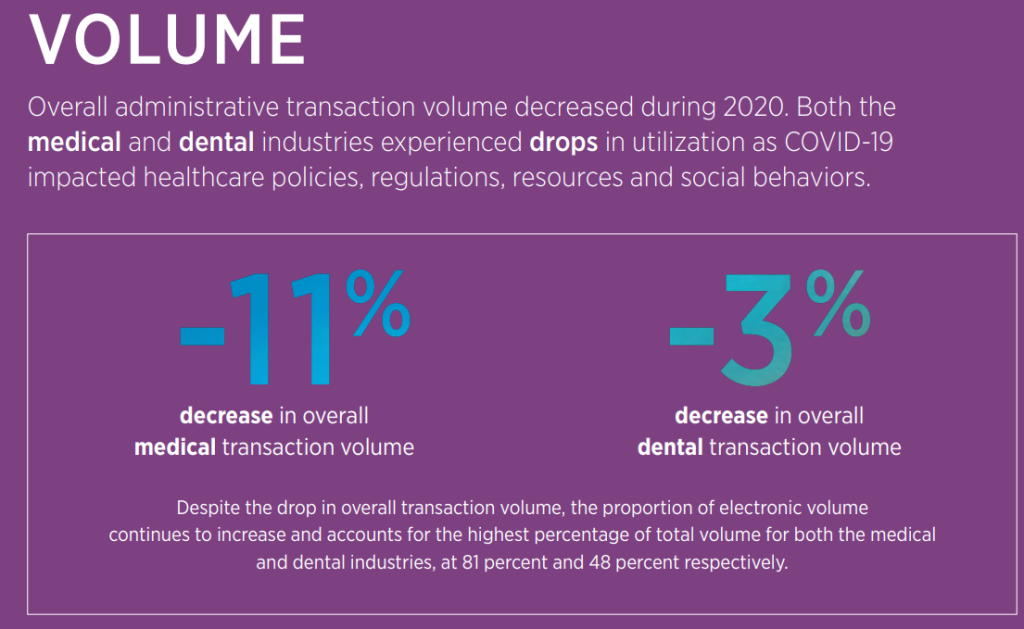
Overall administrative transaction volume decreased during 2020. Both the
medical and dental industries experienced drops in utilization as COVID-19
impacted healthcare policies, regulations, resources and social behaviors.

SPEND

Despite the decrease in overall medical transaction volume and growth in electronic adoption, total annual medical spend increased (12%) as manual transactions required more intensive intervention from providers to ensure that newly implemented requirements and codes were executed correctly and that patient medical records were current and accurate. Conversely, dental spending decreased due to lower utilization often resulting in office closures.

TIME (WASTED!)

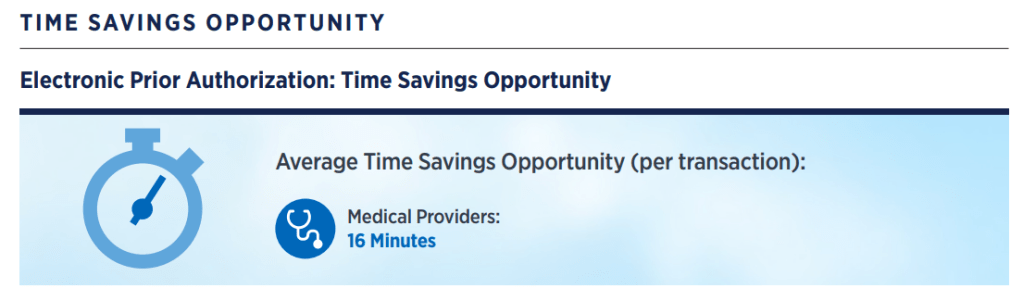
Time Savings Opportunity — The time that providers could save by switching the remaining partially electronic and fully manual time to conduct a transaction to a fully electronic time.

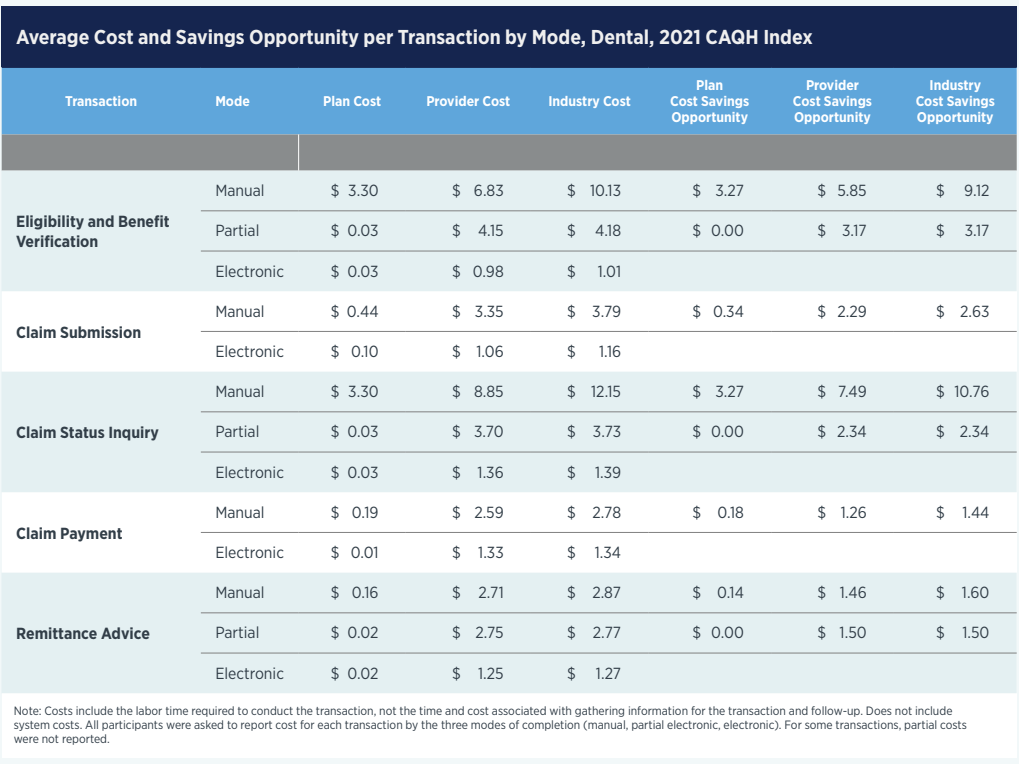
Average Cost and Savings Opportunity per Transaction by Mode, Dental, 2021 CAQH Index