Introducing the Care MAP Tool: A Comprehensive Guide

Introducing the Care MAP Tool, designed to support healthcare providers in managing complex care needs. This user-friendly, Excel-based tool offers a structured framework for effective care coordination, resource allocation, and patient management. With modules for an overview and practical scenarios, plus a comprehensive resource library and FAQ section, the Care MAP Tool enhances care strategies and improves patient outcomes. Download it today and elevate your care management practices.

Effective care management is crucial in today’s complex healthcare landscape. To support healthcare professionals and organizations, we are excited to introduce the Care MAP Tool, a valuable resource designed to aid in complex care management. This blog will provide an overview of the Care MAP Tool, walk you through an example scenario, and offer access to a resource library and frequently asked questions (FAQ) section.

Module 1: Care MAP Overview

The Care MAP (Management and Planning) Tool is designed to support healthcare providers in managing and planning care for patients with complex health needs. This tool provides a structured framework to help clinics navigate the intricacies of care coordination, resource allocation, and patient management. Here’s what you can expect from the Care MAP Tool:

  • Framework for Complex Care Management: The tool offers a comprehensive structure to address the multifaceted needs of patients requiring intensive care management.
  • User-Friendly Interface: The Excel-based tool is intuitive and easy to navigate, ensuring that healthcare providers can quickly integrate it into their workflows.
  • Scalable and Adaptable: Whether you’re a small clinic or a large healthcare organization, the Care MAP Tool can be scaled and adapted to fit your unique needs.

Module 2: Example Scenario

To illustrate the practical application of the Care MAP Tool, let’s walk through an example scenario:

Scenario: Managing a Patient with Multiple Chronic Conditions

  1. Patient Overview:
    • Name: Jane Doe
    • Age: 65
    • Conditions: Diabetes, Hypertension, Chronic Obstructive Pulmonary Disease (COPD)
  2. Initial Assessment:
    • Medical History Review: Gather comprehensive information about Jane’s medical history, including past treatments, hospitalizations, and medications.
    • Social Determinants of Health: Assess factors such as living conditions, access to transportation, and social support.
  3. Care Coordination:
    • Interdisciplinary Team: Form a care team that includes primary care physicians, specialists, nurses, social workers, and community health workers.
    • Care Plan Development: Create a personalized care plan that addresses Jane’s medical and social needs, with clear goals and timelines.
  4. Monitoring and Evaluation:
    • Regular Check-ins: Schedule regular appointments and follow-ups to monitor Jane’s progress.
    • Adjustments: Modify the care plan as needed based on Jane’s response to treatment and changes in her condition.

Resource Library

The Resource Library is a curated collection of materials to further support your use of the Care MAP Tool. Here, you’ll find:

  • Guides and Manuals: Detailed instructions on how to use the Care MAP Tool effectively.
  • Case Studies: Real-world examples of the tool in action, showcasing its impact on patient outcomes.
  • Training Videos: Step-by-step video tutorials to help you and your team get up to speed quickly.

FAQ

To ensure you have all the information you need, we’ve compiled a list of frequently asked questions:

Q1: Who can use the Care MAP Tool?
A1: The tool is designed for healthcare providers, including clinicians, care coordinators, and administrative staff.

Q2: Is there a cost associated with the Care MAP Tool?
A2: No, the Care MAP Tool is available for free download.

Q3: How do I get support if I encounter issues with the tool?
A3: Support is available through our online helpdesk. You can also refer to the Resource Library for troubleshooting guides.

Care MAP Tool Download

By using the Care MAP Tool, you acknowledge that you have read and agree to the disclaimer below. If you share the tool, ensure that all individuals given access to it have reviewed and agreed to the disclaimer language before using it for any purpose.

Disclaimer: The Care MAP Tool is intended as a general framework to support considerations around complex care management in a clinic setting. It is not meant for final staffing, clinical, administrative, operational, and/or financial decision-making. Information obtained from this tool is not and should not be taken as legal or financial advice and is not a substitute for consulting a qualified professional. Community Initiatives does not accept responsibility for any loss that may arise from reliance on this tool.

Source Link:

Download Materials:


Feel free to reach out with any questions or feedback about the Care MAP Tool. Happy planning!
CAQH Index Benchmarks & Time Spent on Administrative Work in Healthcare

The CAQH Index benchmarks adoption, volume, cost savings opportunities and spend for transactions along the administrative workflow. The following metrics help measure progress towards an automated workflow. By tracking progress, the industry can more easily identify barriers that may be delaying automation and administrative simplification and focus efforts on them.

2021 CAQH INDEX®

The CAQH Index benchmarks adoption, volume, cost savings opportunities and spend for transactions along the administrative workflow.  

The CAQH Index benchmarks adoption, volume, cost savings opportunities and spend for transactions along the administrative workflow. The following metrics help measure progress towards an automated workflow. By tracking progress, the industry can more easily identify barriers that may be delaying automation and administrative simplification and focus efforts on them.

ADMINISTRATIVE WORKFLOW


While COVID-19 touched all healthcare professionals, the pandemic impacted the medical and dental administrative workflows differently.

The following touches on MEDICAL and DENTAL.

Utilization

Policies developed by federal and state entities to curb the spread of COVID-19 resulted in lower utilization for both industries as people delayed, or went without, medical care. In general, lower utilization led to lower transaction volumes. Smaller dental practices were hit particularly hard by lower utilization as many offices were forced to close for several months or close permanently.

Spend

Although electronic adoption and volume increased for both industries, the spend associated with conducting administrative transactions varied. While the dental industry saw a drop in spend, the medical industry experienced an increase in spend as it dealt with more complicated factors related to COVID-19

Automation

As remote work increased, many medical and dental staff became more reliant on the use of electronic transactions to conduct business. Staff no longer had access to resources used to conduct manual transactions. Because of this, both industries saw an increase in electronic adoption.

Telemedicine


For the medical industry, the loss in volume was counterbalanced by the increase in telemedicine. Telemedicine expanded access to care while reducing exposure to the virus for staff and patients. Health plans and providers worked together to understand and confirm new requirements and varying codes around telemedicine which often resulted in costly and timely phone calls and manual work. And while manual volume dropped, manual transactions became more expensive, increasing overall spend and the
cost savings opportunity.

While manual volume dropped, manual transactions became more expensive, increasing overall spend and the cost savings opportunity.

While manual volume dropped, manual transactions became more expensive, increasing overall spend and the cost savings opportunity.

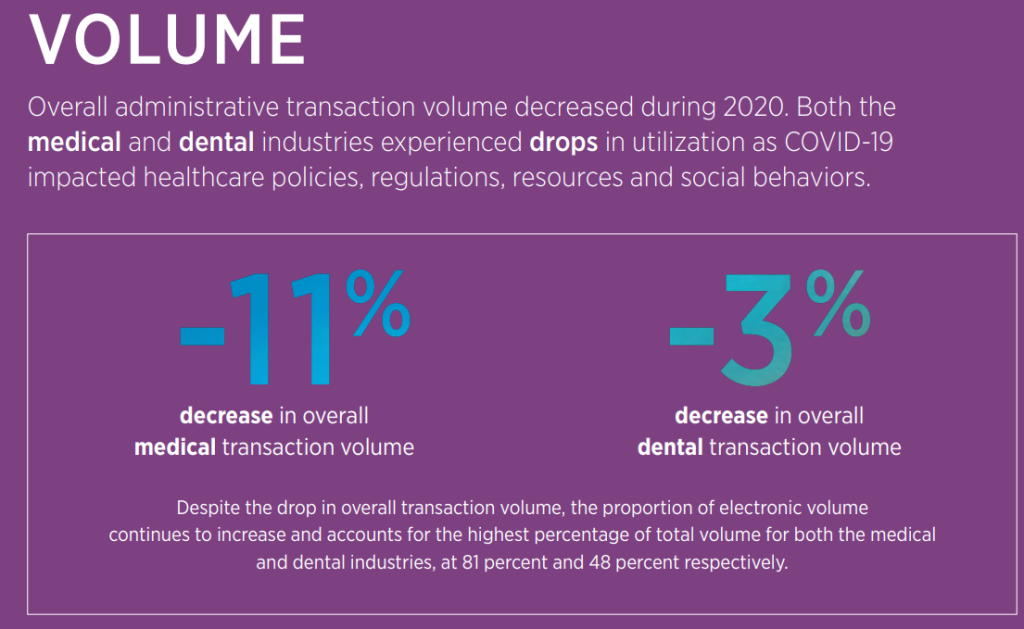
VOLUME

Overall administrative transaction volume decreased during 2020. Both the
medical and dental industries experienced drops in utilization as COVID-19
impacted healthcare policies, regulations, resources and social behaviors.

SPEND

Despite the decrease in overall medical transaction volume and growth in electronic adoption, total annual medical spend increased (12%) as manual transactions required more intensive intervention from providers to ensure that newly implemented requirements and codes were executed correctly and that patient medical records were current and accurate. Conversely, dental spending decreased due to lower utilization often resulting in office closures.

TIME (WASTED!)

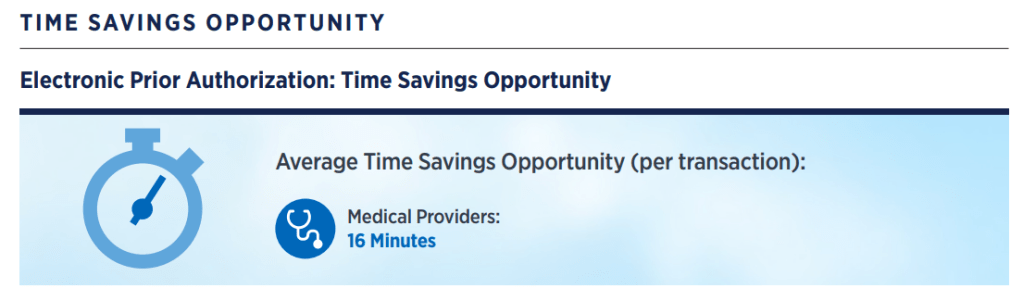
Time Savings Opportunity — The time that providers could save by switching the remaining partially electronic and fully manual time to conduct a transaction to a fully electronic time.

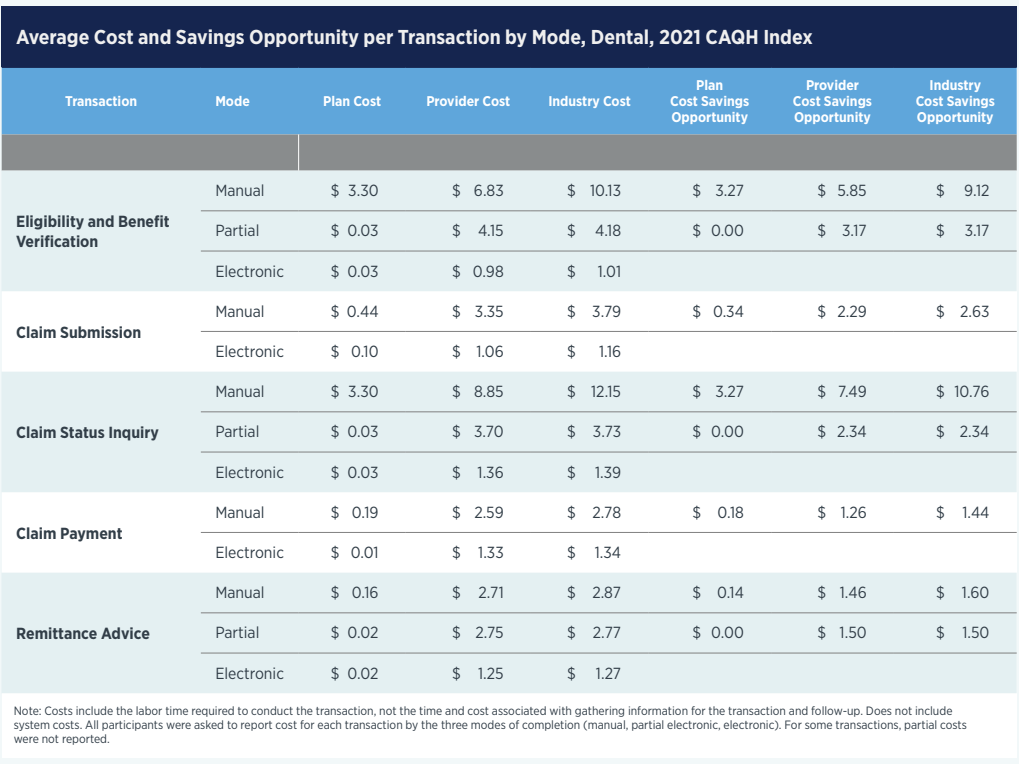
Average Cost and Savings Opportunity per Transaction by Mode, Dental, 2021 CAQH Index