CAQH Index Benchmarks & Time Spent on Administrative Work in Healthcare

The CAQH Index benchmarks adoption, volume, cost savings opportunities and spend for transactions along the administrative workflow. The following metrics help measure progress towards an automated workflow. By tracking progress, the industry can more easily identify barriers that may be delaying automation and administrative simplification and focus efforts on them.

2021 CAQH INDEX®

The CAQH Index benchmarks adoption, volume, cost savings opportunities and spend for transactions along the administrative workflow.  

The CAQH Index benchmarks adoption, volume, cost savings opportunities and spend for transactions along the administrative workflow. The following metrics help measure progress towards an automated workflow. By tracking progress, the industry can more easily identify barriers that may be delaying automation and administrative simplification and focus efforts on them.

ADMINISTRATIVE WORKFLOW


While COVID-19 touched all healthcare professionals, the pandemic impacted the medical and dental administrative workflows differently.

The following touches on MEDICAL and DENTAL.

Utilization

Policies developed by federal and state entities to curb the spread of COVID-19 resulted in lower utilization for both industries as people delayed, or went without, medical care. In general, lower utilization led to lower transaction volumes. Smaller dental practices were hit particularly hard by lower utilization as many offices were forced to close for several months or close permanently.

Spend

Although electronic adoption and volume increased for both industries, the spend associated with conducting administrative transactions varied. While the dental industry saw a drop in spend, the medical industry experienced an increase in spend as it dealt with more complicated factors related to COVID-19

Automation

As remote work increased, many medical and dental staff became more reliant on the use of electronic transactions to conduct business. Staff no longer had access to resources used to conduct manual transactions. Because of this, both industries saw an increase in electronic adoption.

Telemedicine


For the medical industry, the loss in volume was counterbalanced by the increase in telemedicine. Telemedicine expanded access to care while reducing exposure to the virus for staff and patients. Health plans and providers worked together to understand and confirm new requirements and varying codes around telemedicine which often resulted in costly and timely phone calls and manual work. And while manual volume dropped, manual transactions became more expensive, increasing overall spend and the
cost savings opportunity.

While manual volume dropped, manual transactions became more expensive, increasing overall spend and the cost savings opportunity.

While manual volume dropped, manual transactions became more expensive, increasing overall spend and the cost savings opportunity.

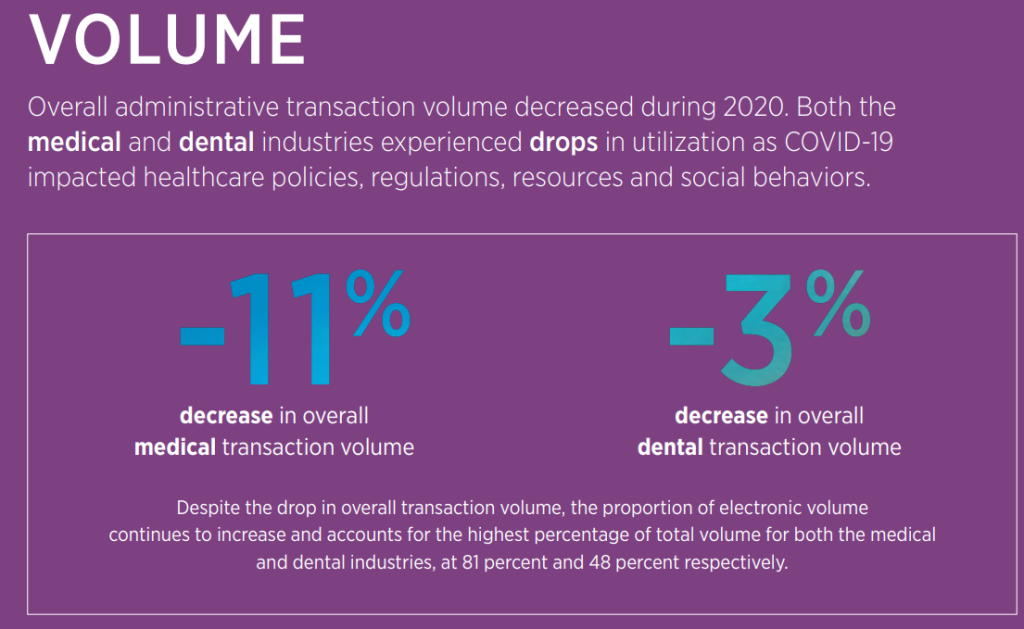
VOLUME

Overall administrative transaction volume decreased during 2020. Both the
medical and dental industries experienced drops in utilization as COVID-19
impacted healthcare policies, regulations, resources and social behaviors.

SPEND

Despite the decrease in overall medical transaction volume and growth in electronic adoption, total annual medical spend increased (12%) as manual transactions required more intensive intervention from providers to ensure that newly implemented requirements and codes were executed correctly and that patient medical records were current and accurate. Conversely, dental spending decreased due to lower utilization often resulting in office closures.

TIME (WASTED!)

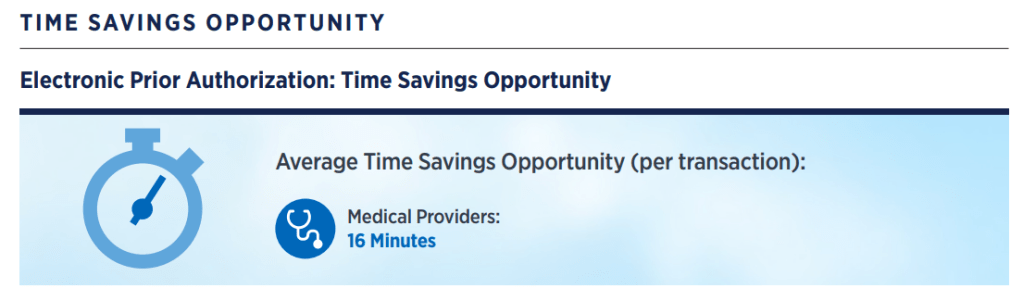
Time Savings Opportunity — The time that providers could save by switching the remaining partially electronic and fully manual time to conduct a transaction to a fully electronic time.

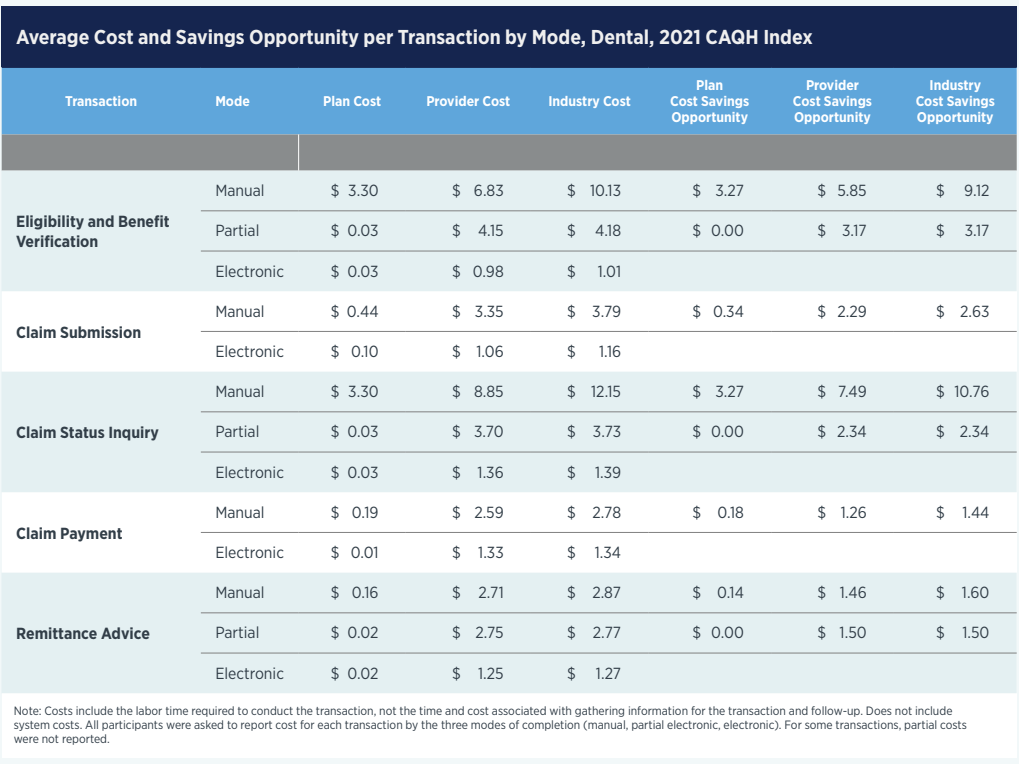
Average Cost and Savings Opportunity per Transaction by Mode, Dental, 2021 CAQH Index
The Millennial Manager’s ‘Dilemma’​

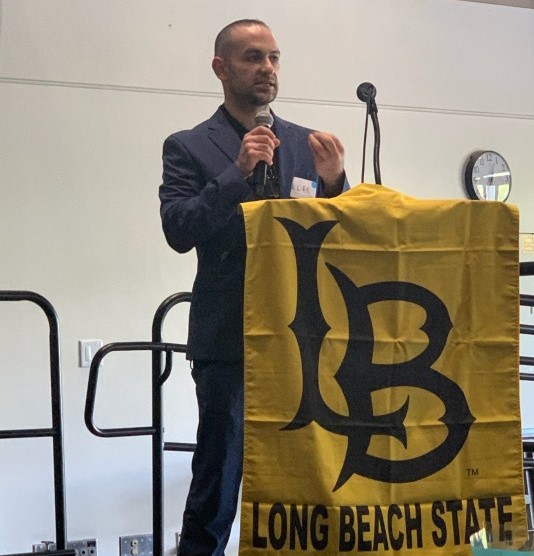
I had the distinct opportunity to serve as a judge for CSULB’s College Bowl 2020, side-by-side with top industry leaders from Kaiser, AltaMed, medical informatics field, the VA, and others.

An attendee asked a great question which I’d like to share with my network.

QUESTION

“Given the undergraduate healthcare administration students are all looking into careers as managers and administrators in healthcare, what are the biggest issues that you see with hiring millennial managers today, how are you and your management team breaking these obstacles, and what characteristics separate a “manager” and a ‘millennial manager’?” 

ANSWER

I don’t see a distinction between a ‘manager’ and a ‘millennial manager’. With that being said, yes, there are challenges surrounding the matter. Being a millennial myself, I think one has to work harder in boardrooms to be taken seriously. As a director (managed care) responsible for negotiating on behalf of over 20K pts, several years ago, while most executives (external as well as internal) were supportive (and appreciated a ‘new/fresh face’) I encountered counterparts who were somewhat — seemingly — condescending …. such that during a lunch meeting, a side-joke was made regarding how I’m “… a baby”.

I learned not to react to both implicit and explicit biases surrounding my relative youth. And look where I am now. C-suite serving over 100K across multiple markets.

College Bowl 2020 at California State University, Long Beach

And look where I am now. C-suite serving over 100K patients across multiple markets.

Do not be discouraged. And try not to see yourself as anything different from your role based on your age alone. Stay to metrics to demonstrate objective performance. Realize that your job as a leader is to set a clear direction, provide resources for team success, and let the team perform while removing barriers which will inevitably surface. Always reflect on the impact and ‘affect’ you have on any place of work (ie.: during your interactions, do folks walk away with a positive or negative net experience). Know that leaders are to inspire their staff and business partners in a given environment).

About 90% of my workforce, across the decade I’ve been in leadership from provider to payer, has been comprised of ‘baby boomers’. 

Know where to throw your weight before throwing your weight around. Listen more as opposed to talking. Know your customers (internal) and have regular 1:1s with your team members to build that relationship. Do not take an authoritative approach as this will backfire on you. Make it about the team, not you. Be responsive to their needs and they will be responsive to yours.

We do not, and should not, discriminate based on age. No matter the age (baby boomer, millennial, or otherwise).

We do not, and should not, discriminate based on age. No matter the age (baby boomer, millennial, or otherwise). We look for leadership skills and ability to align with overall organizational objectives and strategies. 

Do not be self-conscious re: your age as this will show right away. 

The ‘biggest issue’ is a general lack of experience (naturally). Focus on building experience and lead your career based on metrics you have enumerate on your resume. You can always reach out to me for guidance/direction when you get stuck.

I invite my network to add any pointers I might have missed.

How much lip service can we take?

As a longtime healthcare administrator, from managing 28 safety net clinics across CA and TX, to 14 hospitals, over 50 skilled nursing facilities, and 1 national health plan, I’ve seen the inner workings of our ‘systems’ and have a burning passion to contribute to as many solutions as possible.

Healthcare administration is tribal, disjointed, and woven with counterproductive (many times perverse) incentives which go beyond what any ‘tech’ innovation can address. It bothers me when I see nice (undoubtedly creative and expensive) posts and advertisements alleging ‘integration’ and providing claims of having reached new heights while, as a chief officer, I’m sitting here faced with issues of barriers of access to care, onerous requirements for mental health services, and payers (health plans) not paying for preventive screenings unless one fights for these to be paid for.

To my point of ‘tribal knowledge’, had I not managed Humana markets from the payer-side, I would not be able to advocate on behalf of 100K patients we see in our system today.

Integration is a challenge beyond technology. It is painful to see ‘disruptors’ out of firms such as Snapchat and Nokia providing apps to healthcare providers (at incredibly high costs), vacuuming millions of investment dollars, only to cause more issues than solutions. I’ve seen this time and time again.

Until such time payers pay for preventive and integrative care (not just on the med/surg side but within the mental health and substance abuse verticals), zero amount of technological innovations and glorified health technology startups will move the needle in any meaningful, responsible, and effective form.