Medi-Cal Managed Care Enrollment Report

This dataset contains the total number of Medi-Cal Managed Care enrollees based on the reported month, plan type, county, and health plan.

This dataset contains the total number of Medi-Cal Managed Care enrollees based on the reported month, plan type, county, and health plan.

Medi-Cal Managed Care Enrollment Report

The Medi-Cal Managed Care Enrollment Report is a dataset that contains information about the number of people enrolled in Medi-Cal Managed Care plans based on reported month, plan type, county, and health plan. This report is an important tool for policymakers and researchers who want to better understand the state of healthcare in California.
The dataset provides valuable insights into the number of people enrolled in Medi-Cal Managed Care plans, which are designed to provide affordable healthcare to low-income Californians. By analyzing the data in the report, policymakers and researchers can identify trends in enrollment, plan type, and county-level differences in enrollment rates.

One important trend that the report highlights is the increasing popularity of Medi-Cal Managed Care plans. As of the latest reported month, the total number of people enrolled in these plans was higher than ever before, indicating that more Californians are taking advantage of these affordable healthcare options.

Another important trend is the differences in enrollment rates across different counties in California. The report shows that some counties have higher enrollment rates than others, indicating that there may be disparities in access to healthcare across the state.

Overall, the Medi-Cal Managed Care Enrollment Report is an essential resource for anyone interested in understanding the state of healthcare in California. By providing detailed information about enrollment in Medi-Cal Managed Care plans, this report can help policymakers and researchers identify areas where improvements can be made, and ensure that all Californians have access to affordable, high-quality healthcare.
Medi-Cal Managed Care Enrollment Report

CAQH Index Benchmarks & Time Spent on Administrative Work in Healthcare

The CAQH Index benchmarks adoption, volume, cost savings opportunities and spend for transactions along the administrative workflow. The following metrics help measure progress towards an automated workflow. By tracking progress, the industry can more easily identify barriers that may be delaying automation and administrative simplification and focus efforts on them.

2021 CAQH INDEX®

The CAQH Index benchmarks adoption, volume, cost savings opportunities and spend for transactions along the administrative workflow.  

The CAQH Index benchmarks adoption, volume, cost savings opportunities and spend for transactions along the administrative workflow. The following metrics help measure progress towards an automated workflow. By tracking progress, the industry can more easily identify barriers that may be delaying automation and administrative simplification and focus efforts on them.

ADMINISTRATIVE WORKFLOW


While COVID-19 touched all healthcare professionals, the pandemic impacted the medical and dental administrative workflows differently.

The following touches on MEDICAL and DENTAL.

Utilization

Policies developed by federal and state entities to curb the spread of COVID-19 resulted in lower utilization for both industries as people delayed, or went without, medical care. In general, lower utilization led to lower transaction volumes. Smaller dental practices were hit particularly hard by lower utilization as many offices were forced to close for several months or close permanently.

Spend

Although electronic adoption and volume increased for both industries, the spend associated with conducting administrative transactions varied. While the dental industry saw a drop in spend, the medical industry experienced an increase in spend as it dealt with more complicated factors related to COVID-19

Automation

As remote work increased, many medical and dental staff became more reliant on the use of electronic transactions to conduct business. Staff no longer had access to resources used to conduct manual transactions. Because of this, both industries saw an increase in electronic adoption.

Telemedicine


For the medical industry, the loss in volume was counterbalanced by the increase in telemedicine. Telemedicine expanded access to care while reducing exposure to the virus for staff and patients. Health plans and providers worked together to understand and confirm new requirements and varying codes around telemedicine which often resulted in costly and timely phone calls and manual work. And while manual volume dropped, manual transactions became more expensive, increasing overall spend and the
cost savings opportunity.

While manual volume dropped, manual transactions became more expensive, increasing overall spend and the cost savings opportunity.

While manual volume dropped, manual transactions became more expensive, increasing overall spend and the cost savings opportunity.

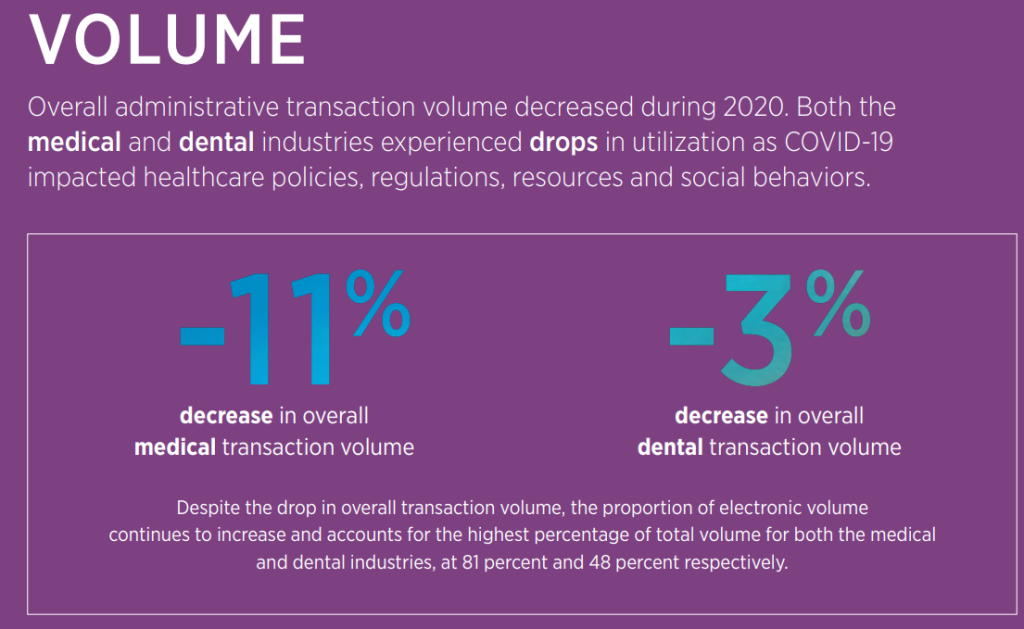
VOLUME

Overall administrative transaction volume decreased during 2020. Both the
medical and dental industries experienced drops in utilization as COVID-19
impacted healthcare policies, regulations, resources and social behaviors.

SPEND

Despite the decrease in overall medical transaction volume and growth in electronic adoption, total annual medical spend increased (12%) as manual transactions required more intensive intervention from providers to ensure that newly implemented requirements and codes were executed correctly and that patient medical records were current and accurate. Conversely, dental spending decreased due to lower utilization often resulting in office closures.

TIME (WASTED!)

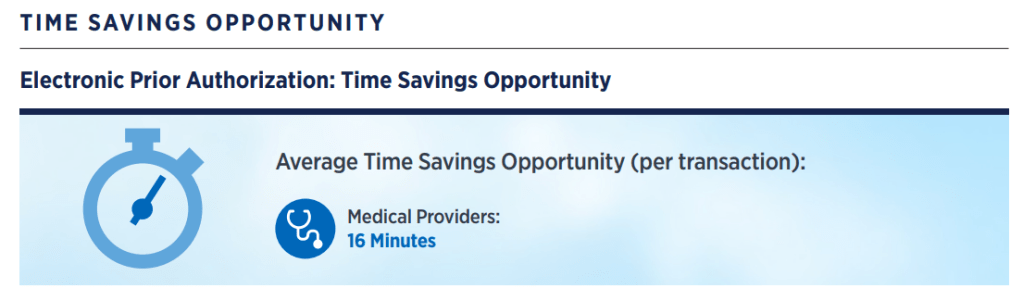
Time Savings Opportunity — The time that providers could save by switching the remaining partially electronic and fully manual time to conduct a transaction to a fully electronic time.

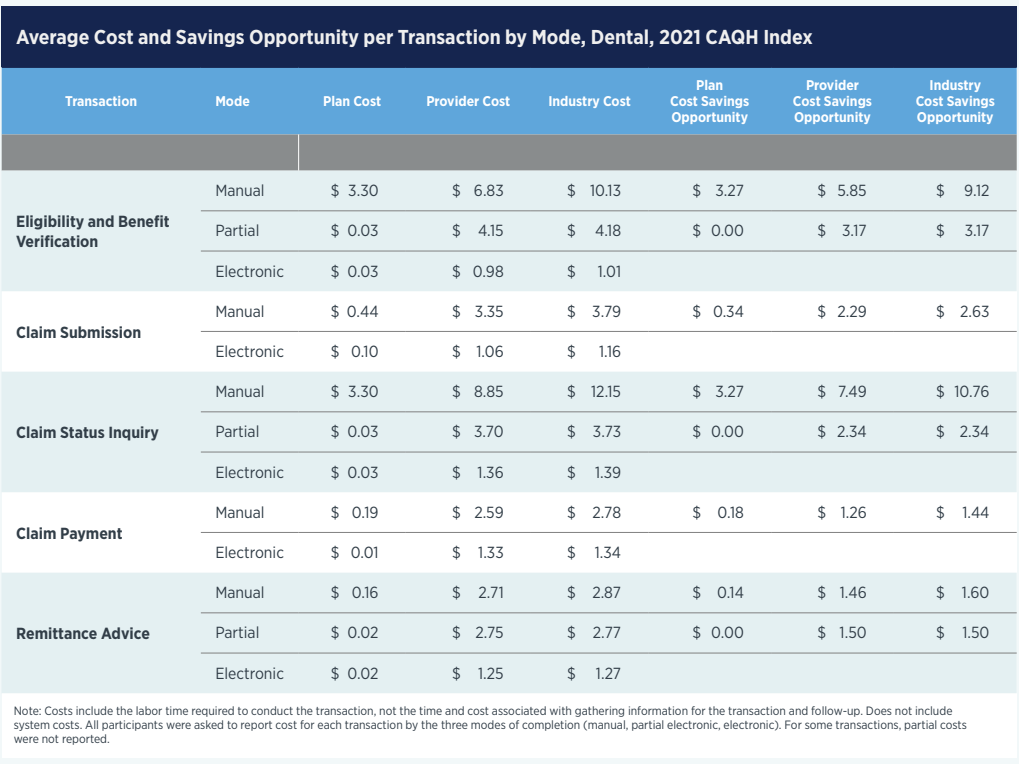
Average Cost and Savings Opportunity per Transaction by Mode, Dental, 2021 CAQH Index