Maryland Physicians Care (MPC) Provider Relations Representatives Maryland Physicians Care

Maryland Physicians Care (MPC) Provider Relations Representatives Maryland Physicians Care

Maryland Physicians Care (MPC) Provider Relations Representatives Maryland Physicians Care

MPC providers have designated Provider Relations Representatives based on the practice/group location. This specialist will be your primary contact with MPC and will keep you updated on any policy changes. To find your Provider Relations Representative, select a territory for the list below.

Phone: 1-800-953-8854 (follow prompts to PR dept.)
Fax: 866-333-8024

Download the Territory List

MPC Provider Relations Representatives

ROI Calculator for Partnerships to Address Social Determinants of Health

The ROI Calculator for Partnerships to Address Social Determinants of Health is a tool designed to help CBOs and their health care partners explore, structure, and plan financial arrangements to fund social services for people with complex needs. The tool allows health systems, payers, medical providers, social service providers, and CBOs to determine the overall return on investment from integrating social services with medical care under different payment models.

Healthcare organizations are increasingly partnering with community-based organizations (CBOs) to address patients’ health-related social needs such as nutrition, housing, and transportation. These partnerships can help integrate services for people with complex needs, but health care and social service organizations often struggle to establish partnerships and contracts given their different structures and financial resources.

Access the ROI Calculator for Partnerships to Address Social Determinants of Health (ROI Calculator) — designed to assist CBOs and their health care partners to explore, structure, and plan financial arrangements to fund social services for people with complex needs.

The ROI Calculator for Partnerships to Address Social Determinants of Health is a tool designed to help CBOs and their health care partners explore, structure, and plan financial arrangements to fund social services for people with complex needs. The tool allows health systems, payers, medical providers, social service providers, and CBOs to determine the overall return on investment from integrating social services with medical care under different payment models.

This Better Care Playbook webinar describes the application of the ROI Calculator to health care organizations and CBOs. It features a case example of a Washington State CBO that used the tool to quantify the value of their services when developing a partnership with a Medicare Advantage plan.

ROI Forecasting Calculator for Quality Initiatives

The ROI Forecasting Calculator is an excellent tool for any organization looking to improve quality while keeping costs under control. It can help identify where to make investments in quality, how to prioritize proposed initiatives, and how to demonstrate the financial benefits of investing in quality initiatives. By demonstrating potential cost savings, this tool can also help organizations identify potential areas where they can reduce costs while maintaining or improving quality.

As healthcare costs continue to rise, there is an increasing need to find ways to improve quality while keeping expenses under control. The ROI Forecasting Calculator for Quality Initiatives is a web-based tool that is designed to help state Medicaid agencies, health plans, and other stakeholders assess and demonstrate the cost-savings potential of efforts to improve quality.

The ROI Calculator is an easy-to-use tool that walks users through a step-by-step process to develop ROI forecasts for proposed quality initiatives. Users are asked to enter a variety of assumptions, including target population characteristics, program costs, and expected changes in healthcare utilization. By using these assumptions, the ROI Calculator can help determine where to make investments in quality and how to target proposed initiatives for maximum financial impact.

One of the most significant benefits of the ROI Forecasting Calculator is that it can create a financial case to policymakers for obtaining the resources needed to make those investments in the first place. By demonstrating the financial impacts of investments in quality beyond their upfront costs, the calculator can help policymakers understand the long-term benefits of investing in quality initiatives.

The ROI Forecasting Calculator is an excellent tool for any organization looking to improve quality while keeping costs under control. It can help identify where to make investments in quality, how to prioritize proposed initiatives, and how to demonstrate the financial benefits of investing in quality initiatives. By demonstrating potential cost savings, this tool can also help organizations identify potential areas where they can reduce costs while maintaining or improving quality.

In addition to helping organizations make informed decisions about quality initiatives, the ROI Forecasting Calculator can also improve collaboration between stakeholders. By providing a clear picture of the financial benefits of proposed quality initiatives, the calculator can help stakeholders understand each other’s perspectives and work together to make informed decisions.

Overall, the ROI Forecasting Calculator is an essential tool for any organization looking to improve quality while keeping costs under control. By providing a clear picture of the financial benefits of proposed quality initiatives, this tool can help organizations make informed decisions, collaborate effectively, and ultimately improve the quality of care for patients.

If you’re interested in learning more about the ROI Forecasting Calculator, you can visit CHCSROI.org to access the tool and start forecasting potential savings. Don’t wait; start using this powerful tool to improve quality and control costs today!

Return on Investment Calculator (R.O.I.) for College Mental Health Services and Programs

The tool is easy to use and only requires a handful of questions about your institution, including enrollment size, approximate institutional drop-out rate, and approximate per student tuition rate. Based on this information, the calculator will give economic estimates for both your institution and students.

This tool will allow you to calculate the economic returns of services or programs that improve mental health in your student population.

You will be asked a handful of questions about your campus, including:

  • Enrollment size
  • Approximate institutional drop-out rate
  • Approximate per student tuition rate

Based on the information you provide, the calculator will give economic estimates for both your institution and students.

Your proposed services or programs could be focused on mental health treatment or could also seek to prevent mental health issues. They could be new or expanded offerings that your campus is considering, or they could be existing services.

The calculator’s estimates are based on research by the Healthy Minds Network. This research examined how depressive symptoms predict student persistence in college. The estimates, therefore, are most accurate for services and programs that specifically reduce depressive symptoms. The estimates may also extend to services and programs that address other mental health concerns, such as anxiety. The original research article with more details is available here as well as the Healthy Minds website.

Access the calculator here.

Comprehensive Medicaid Actuarial Data (FL)

Advanced financial and statistical support relating to Capitation Rates, Risk Adjustment Models, and Payment Methodologies.


Agency: Florida Agency for Health Care Administration

Market: Florida

Line of Business: Medicaid


Market: Florida

Line of Business: Medicaid

Agency: Florida Agency for Health Care Administration

Source: Medicaid Actuarial Services


Advanced financial and statistical support relating to Capitation Rates, Risk Adjustment Models, and Payment Methodologies.

Medicaid Actuarial Services

This post is useful for those seeking information on Medicaid actuarial services and related rates in Florida.

  • Outlines Medicaid actuarial services provided by the Bureau, including advanced financial and statistical support for Capitation Rates, Risk Adjustment Models, and Payment Methodologies.
  • Provides information on Managed Medical Assistance (MMA), Long-Term Care (LTC), and Dental Capitation Rates for various years.
  • Includes a link to a Special Needs Plan Revenue and Expense Schedule Statement Template Tool.

Unit Responsibilities include:

  • Support of Capitation Rate Development and Adjustment
  • Management of External Actuarial Service Contracts
  • Monitoring Medicaid Program Changes
  • Trend Analysis
  • Rate Impact Analysis

Medicaid Actuarial Services

This post is useful for those seeking information on Medicaid actuarial services and related rates in Florida.

  • Outlines Medicaid actuarial services provided by the Bureau, including advanced financial and statistical support for Capitation Rates, Risk Adjustment Models, and Payment Methodologies.
  • Provides information on Managed Medical Assistance (MMA), Long-Term Care (LTC), and Dental Capitation Rates for various years.
  • Includes a link to a Special Needs Plan Revenue and Expense Schedule Statement Template Tool.

For Institutional Reimbursement rates, please click here.

SMMC Capitation Information

Managed Medical Assistance (MMA)

Long-Term Care (LTC)

Dental

Medicare Dual Eligible Special Needs Plans (D-SNPs) and Fully Liable Medicare Advantage Plans

Special Needs Plan Revenue and Expense Schedule Statement Template Tool excel 160.5 kB ] Effective July 1

Medi-Cal Managed Care Enrollment Report

This dataset contains the total number of Medi-Cal Managed Care enrollees based on the reported month, plan type, county, and health plan.

This dataset contains the total number of Medi-Cal Managed Care enrollees based on the reported month, plan type, county, and health plan.

Medi-Cal Managed Care Enrollment Report

The Medi-Cal Managed Care Enrollment Report is a dataset that contains information about the number of people enrolled in Medi-Cal Managed Care plans based on reported month, plan type, county, and health plan. This report is an important tool for policymakers and researchers who want to better understand the state of healthcare in California.

The dataset provides valuable insights into the number of people enrolled in Medi-Cal Managed Care plans, which are designed to provide affordable healthcare to low-income Californians. By analyzing the data in the report, policymakers and researchers can identify trends in enrollment, plan type, and county-level differences in enrollment rates.

One important trend that the report highlights is the increasing popularity of Medi-Cal Managed Care plans. As of the latest reported month, the total number of people enrolled in these plans was higher than ever before, indicating that more Californians are taking advantage of these affordable healthcare options.

Another important trend is the differences in enrollment rates across different counties in California. The report shows that some counties have higher enrollment rates than others, indicating that there may be disparities in access to healthcare across the state.

Overall, the Medi-Cal Managed Care Enrollment Report is an essential resource for anyone interested in understanding the state of healthcare in California. By providing detailed information about enrollment in Medi-Cal Managed Care plans, this report can help policymakers and researchers identify areas where improvements can be made, and ensure that all Californians have access to affordable, high-quality healthcare.

Medi-Cal Managed Care Enrollment Report

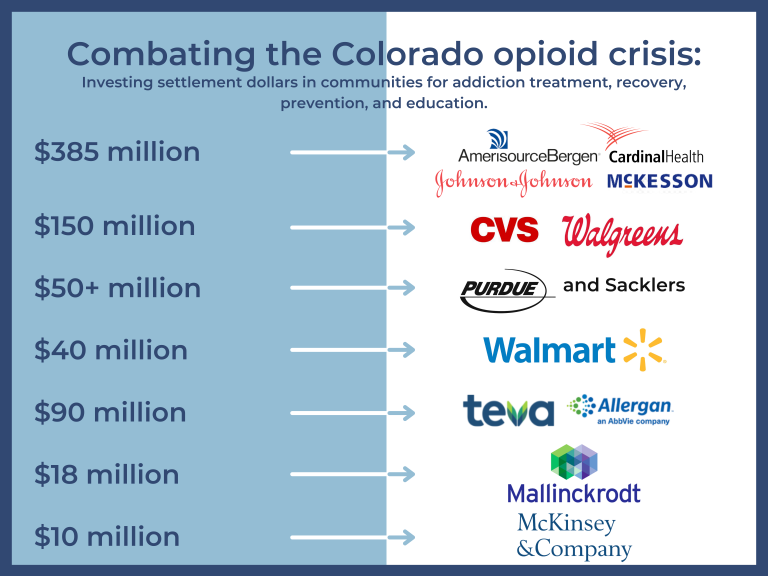
Opioid Settlement Distribution: Colorado Regions

Opioid Settlement Distribution: Colorado Regions

View and download the regional and local government funding distribution data sheet. The figures contained in the data sheet are the best estimates at this time and may be subject to adjustments at a later date. Additionally, the opioid settlement funds will be different from year to year and will be adjusted as needed.

Colorado Opioid Abatement Council

The Colorado Opioid Abatement Council (COAC) was created by the Department of Law in agreement with local governments to provide oversight of the opioid funds and to ensure the distribution of those funds complies with the terms of any settlement and the Colorado Opioid Settlement Memorandum of Understanding. The COAC is specifically responsible for oversight of opioid funds from the regional share and for developing processes and procedures for the statewide infrastructure share.

The COAC works with the 19 Regional Opioid Abatement Councils to distribute opioid settlement funds for substance use disorder treatment, recovery, harm reduction, law enforcement, and prevention/education programs. The COAC consists of seven members appointed by the State and six members appointed by local governments. Click here to view the full roster.

Opioid abatement infrastructure funding

The COAC is responsible for the distribution and oversight of the Infrastructure Share, which makes up 10% of the opioid settlement funds received by Colorado. The purpose of the Infrastructure Share is to promote capital improvements and provide operational assistance for developing or improving the infrastructure necessary to abate the opioid crisis within the state of Colorado.

The Infrastructure Share is intended to supplement other opioid settlement funds by providing additional funds to areas of greatest need. These funds are also intended to encourage cross-regional collaboration among the 19 opioid settlement regions.

Opioid Settlement Funds Distribution Data

View the opioid fund distribution dashboard

CAQH Index Benchmarks & Time Spent on Administrative Work in Healthcare

The CAQH Index benchmarks adoption, volume, cost savings opportunities and spend for transactions along the administrative workflow. The following metrics help measure progress towards an automated workflow. By tracking progress, the industry can more easily identify barriers that may be delaying automation and administrative simplification and focus efforts on them.

2021 CAQH INDEX®

The CAQH Index benchmarks adoption, volume, cost savings opportunities and spend for transactions along the administrative workflow.  

The CAQH Index benchmarks adoption, volume, cost savings opportunities and spend for transactions along the administrative workflow. The following metrics help measure progress towards an automated workflow. By tracking progress, the industry can more easily identify barriers that may be delaying automation and administrative simplification and focus efforts on them.

ADMINISTRATIVE WORKFLOW


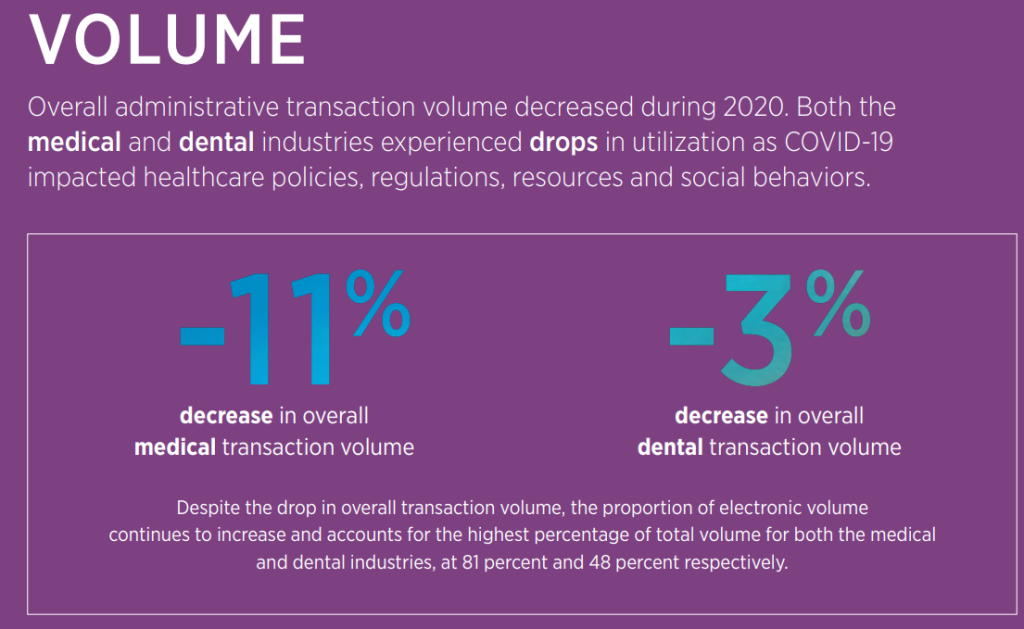
While COVID-19 touched all healthcare professionals, the pandemic impacted the medical and dental administrative workflows differently.

The following touches on MEDICAL and DENTAL.

Utilization

Policies developed by federal and state entities to curb the spread of COVID-19 resulted in lower utilization for both industries as people delayed, or went without, medical care. In general, lower utilization led to lower transaction volumes. Smaller dental practices were hit particularly hard by lower utilization as many offices were forced to close for several months or close permanently.

Spend

Although electronic adoption and volume increased for both industries, the spend associated with conducting administrative transactions varied. While the dental industry saw a drop in spend, the medical industry experienced an increase in spend as it dealt with more complicated factors related to COVID-19

Automation

As remote work increased, many medical and dental staff became more reliant on the use of electronic transactions to conduct business. Staff no longer had access to resources used to conduct manual transactions. Because of this, both industries saw an increase in electronic adoption.

Telemedicine


For the medical industry, the loss in volume was counterbalanced by the increase in telemedicine. Telemedicine expanded access to care while reducing exposure to the virus for staff and patients. Health plans and providers worked together to understand and confirm new requirements and varying codes around telemedicine which often resulted in costly and timely phone calls and manual work. And while manual volume dropped, manual transactions became more expensive, increasing overall spend and the
cost savings opportunity.

While manual volume dropped, manual transactions became more expensive, increasing overall spend and the cost savings opportunity.

While manual volume dropped, manual transactions became more expensive, increasing overall spend and the cost savings opportunity.

VOLUME

Overall administrative transaction volume decreased during 2020. Both the
medical and dental industries experienced drops in utilization as COVID-19
impacted healthcare policies, regulations, resources and social behaviors.

SPEND

Despite the decrease in overall medical transaction volume and growth in electronic adoption, total annual medical spend increased (12%) as manual transactions required more intensive intervention from providers to ensure that newly implemented requirements and codes were executed correctly and that patient medical records were current and accurate. Conversely, dental spending decreased due to lower utilization often resulting in office closures.

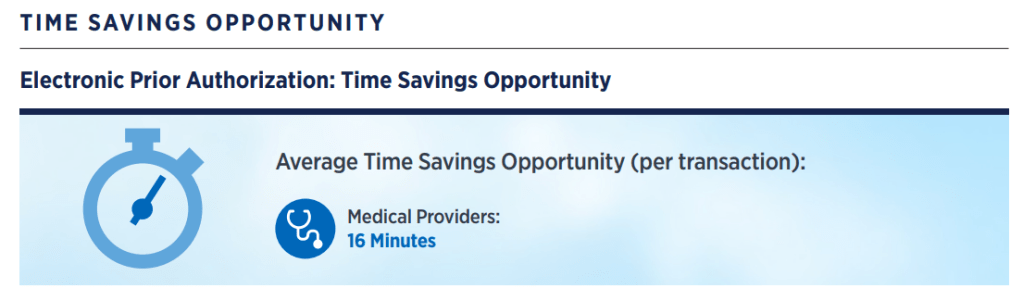
TIME (WASTED!)

Time Savings Opportunity — The time that providers could save by switching the remaining partially electronic and fully manual time to conduct a transaction to a fully electronic time.

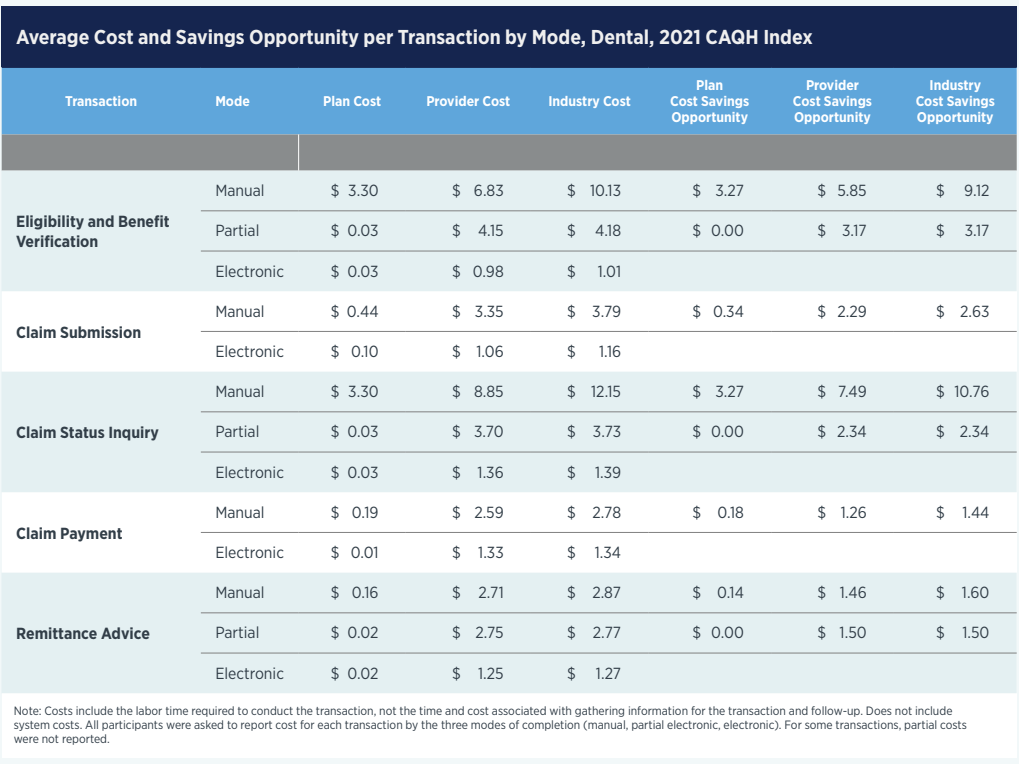
Average Cost and Savings Opportunity per Transaction by Mode, Dental, 2021 CAQH Index

Medi-Cal Managed Care Quality Improvement Reports (CA)

Various reports from the State of California regarding the quality of care provided by Medi-Cal managed care health plans. Plan-specific evaluation reports are also prepared for each individual health plan reviewed.

The California Department of Health Care Services contracts with an external quality review organization to evaluate the care provided to Medi-Cal managed care beneficiaries in the areas of quality, access, and timeliness. Reports are available on the DHCS website, including member satisfaction surveys, encounter data validation study reports, managed care accountability sets, external quality review technical reports, plan-specific evaluation reports, health disparity reports, HEDIS® reports, MCP-specific performance evaluation reports, performance improvement project reports, and preventive services reports.

Outline

  • Introduction: Purpose of the DHCS external quality review organization
  • Available Reports:
    • Member Satisfaction Surveys
    • Encounter Data Validation Study Reports
    • Managed Care Accountability Sets/External Accountability Sets
    • External Quality Review Technical Reports and Plan-Specific Evaluation Reports
    • Health Disparity Reports
    • HEDIS® Reports
    • MCP-Specific Performance Evaluation Reports
    • Performance Improvement Project Reports
    • Preventive Services Report
  • Conclusion: Summary of available reports and their purpose.

In accordance with federal requirements, the California Department of Health Care Services (DHCS) contracts with an external quality review organization (EQRO) to conduct external quality reviews and evaluate the care provided to beneficiaries by Medi-Cal managed care health plans (MCPs) in the areas of quality, access, and timeliness. The EQRO presents these external quality review activities, results, and assessments in reports that help DHCS and Medi-Cal MCPs understand where to focus resources to further improve the quality of care.

Medi-Cal Managed Care Quality Strategy Reports

The Medi-Cal Managed Care Quality Strategy Reports are DHCS’ written strategy for assessing and improving the quality of managed care services offered by all Medi-Cal MCPs.

Member Satisfaction Surveys (CAHPS® Surveys)

Each Consumer Assessment of Healthcare Providers and Systems (CAHPS®) survey report aggregates the results of CAHPS® surveys, which ask Medi-Cal managed care beneficiaries to evaluate their experiences with their health care health care providers.

Encounter Data Validation Study Reports

Encounter Data Validation (EDV) Study Reports examine the completeness and accuracy of the encounter data submitted to DHCS by the MCPs.

Managed Care Accountability Sets / External Accountability Sets

The Managed Care Accountability Sets (MCAS) / External Accountability Set (EAS) is a set of performance measures that DHCS selects for annual reporting by Medi-Cal MCPs.

External Quality Review Technical Reports and Plan-Specific Evaluation Reports

The EQRO annually prepares an independent external quality review technical report that analyzes and evaluates aggregated information on the health care services provided by Medi-Cal MCPs. As part of the external quality review technical report, the EQRO prepares a plan-specific evaluation report of each of MCP.

Access these reports on the Medi-Cal Managed Care External Quality Review Technical Reports with Plan-Specific Evaluation Reports.

Health Disparity Reports

The Health Disparity Reports identify and understand health disparities affecting California’s Medi-Cal managed care members and are based on focused studies conducted annually by the EQRO. The reports analyze Managed Care Accountability Set (MCAS) measure results reported by Medi-Cal managed care plans (MCPs) for various demographic categories.

HEDIS® Reports

The Healthcare Effectiveness Data and Information Set (HEDIS®) Aggregate Report, also referred to as Performance Measurement Reports, provides performance rates of MCPs during a reporting year and trending using previous years’ data. The report also compares plan-specific and aggregated rates to national benchmarks.

MCP-Specific Performance Evaluation Reports

The MCP-Specific Performance Evaluation Reports are also referred to as Plan-Specific Performance Evaluation Reports.

Access these reports on the Medi-Cal Managed Care Quality Improvement Reports webpage

Performance Measures and HEDIS® Reports

Access Medi-Cal Managed Care’s annual performance measure, External Accountability Set, on the Medi-Cal Managed Care Quality Improvement Reports webpage.

The following performance measure results are also available on our website:

Performance Improvement Project Reports

Plan-Specific Performance Evaluation Reports

Plan-Specific Performance Evaluation Reports are also referred to as MCP-Specific Performance Evaluation Reports.

Access the reports on the  Medi-Cal Managed Care Quality Improvement Reports: External Quality Review Technical Reports and Plan-Specific Evaluation Reports.

Quality Improvement Project Reports

Quality Improvement Project (QIP) Reports are available on the Medi-Cal Managed Care Quality Improvement Reports: Quality Improvement Project Reports webpage.

Technical Reports

Technical Reports are available on the Medi-Cal Managed Care Quality Improvement Reports: External Quality Review Technical Reports webpage.

Preventive Services Report

The 2021 Preventive Services Report and Executive Summary assist with identifying and monitoring appropriate utilization of preventive services for children in Medi-Cal Managed Care.

The 2020 Preventive Services Report and Addendum assesses the provision of preventive services by pediatric Medi-Cal managed care members.

Eligibility: Contract Language (Payer v Provider) and Sample to Use

Eligibility: Contract Language (Payer v Provider) and Sample to Use.

Payer contracting negotiations are a critical aspect of managing healthcare costs and ensuring access to care for patients. During contract negotiations, payers and providers work to establish agreements on reimbursement rates, covered services, and other important details. These negotiations can be complex and time-consuming, requiring careful attention to legal and financial considerations. Ultimately, successful negotiations can help to ensure that patients receive high-quality care at a reasonable cost, while providers are fairly compensated for their services. 

What language to negotiate from a provider v a payer’s perspective:

Favorable to physician:


Payor shall be responsible for identifying and verifying eligibility of Members. Payor shall provide each Member with an identification card. It is the Payor’s responsibility to update and maintain eligibility files and systems to ensure that eligibility verification is timely and accurate. Physician may rely on eligibility verifications obtained from a Payor or its designee and Payor shall reimburse Physician in accordance with this Agreement even if a Member is later determined to be ineligible on the date of service.


Favorable to payor:


Physician will verify a Member’s eligibility before providing a Covered Service unless the situation involves the provision of an Emergency Service in which case Physician will confirm eligibility in a manner that is consistent with Law on redeterminations of eligibility. Physician will not be reimbursed for any services furnished to a patient who was not an eligible Member on the date of service