The 2025 Healthcare Perfect Storm: How Rising Costs and Increased Scrutiny Impact Insurers

The blog post examines the health insurance industry’s challenges in 2025, highlighting rising healthcare costs, increased patient demand, and heightened government scrutiny. Insurers, particularly those focused on Medicare Advantage, must reevaluate strategies to maintain profitability. Despite these hurdles, opportunities for innovation and growth exist through personalized care and strategic partnerships.

This blog post delves into the complex challenges facing the health insurance industry in 2025, a year poised to be a pivotal moment for insurers, particularly those heavily invested in Medicare Advantage plans. Rising healthcare costs, increased patient demand, and heightened government scrutiny are converging to create what we’re calling a “perfect storm.” This confluence of factors threatens profitability and necessitates a critical reevaluation of existing operational strategies. This post expands on the themes discussed in our latest podcast episode, exploring these challenges in greater depth and offering insights into potential solutions for both insurers and healthcare providers.

Rising Healthcare Costs: A Looming Crisis

The escalating cost of healthcare is arguably the most significant challenge facing insurers. Inflation, technological advancements, and the increasing complexity of medical treatments all contribute to this unsustainable upward trend. The post-COVID surge in patient utilization, with many seeking deferred procedures, has exacerbated the problem, placing immense pressure on insurers’ financial reserves. This increased demand is straining existing resources and impacting profitability, pushing medical loss ratios (MLRs) higher than ever before. The implications are profound, forcing insurers to re-evaluate pricing strategies, negotiate more effectively with providers, and explore innovative cost-containment measures.

The Impact on Medicare Advantage

Medicare Advantage (MA) plans, once considered a goldmine for insurers, are particularly vulnerable in this environment. The increased demand for MA plans, coupled with rising healthcare costs, is squeezing profit margins. Major players like Humana and UnitedHealth Group, heavily reliant on MA for revenue, are grappling with these challenges head-on. Their financial performance is becoming increasingly dependent on their ability to manage costs efficiently while maintaining patient satisfaction and adherence to regulatory requirements.

Increased Patient Demand: A Double-Edged Sword

While increased patient demand initially appears beneficial, in the context of rising costs, it becomes a major challenge. Insurers are faced with a difficult balancing act: fulfilling the needs of a growing patient population while simultaneously controlling costs and maintaining profitability. This necessitates a shift towards more proactive and personalized care models that prioritize preventative measures and disease management. Strategic partnerships with providers are crucial for achieving these goals.

The Need for Personalized Care

The sheer volume of patients requires a move beyond traditional, reactive models of care. Personalized care, driven by data analysis and predictive modeling, is becoming essential for identifying high-risk individuals and implementing targeted interventions. This approach not only improves patient outcomes but also helps to manage healthcare costs more effectively, ultimately impacting the MLR and safeguarding insurer profitability.

Increased Government Scrutiny: Navigating Regulatory Hurdles

The health insurance industry is facing unprecedented levels of government scrutiny. Lawmakers are increasingly focused on issues of transparency, affordability, and access to care. This heightened scrutiny translates into stricter regulations, increased audits, and potential penalties for non-compliance. Insurers must navigate this complex regulatory landscape while ensuring they maintain ethical and transparent practices.

Adapting to Regulatory Changes

The regulatory environment is constantly evolving, requiring insurers to be adaptable and proactive. Staying informed about new regulations, investing in compliance programs, and engaging with policymakers are crucial for navigating this challenging landscape. Failure to adapt could lead to significant financial penalties and reputational damage.

Opportunities Amidst the Storm

While the challenges are significant, the current climate also presents opportunities for innovation and growth. Entrepreneurs and healthcare providers can leverage this disruption by focusing on high-cost patient areas and developing innovative solutions that improve efficiency and reduce waste within the healthcare system. New models of care, such as value-based care, offer potential avenues for both improved patient outcomes and reduced costs.

Innovation in Healthcare Delivery

The need for cost-effective and efficient healthcare delivery models has never been greater. Entrepreneurs are stepping up to the plate, developing innovative technologies and solutions to address these challenges. These range from telehealth platforms and remote monitoring devices to AI-powered diagnostic tools and personalized treatment plans. Insurers that embrace these innovations and forge strategic partnerships with these innovators will be better positioned to thrive in the evolving healthcare landscape.

Conclusion

The healthcare industry in 2025 faces a perfect storm of rising costs, increasing patient demand, and intensified regulatory scrutiny. Insurers, especially those heavily reliant on Medicare Advantage, are experiencing significant financial pressure. This necessitates a complete re-evaluation of operational strategies, focusing on cost containment, personalized care, and proactive compliance. However, amidst these challenges lie significant opportunities for innovation and growth. By embracing new technologies, fostering strategic partnerships, and prioritizing patient-centric care models, both insurers and healthcare providers can navigate this turbulent environment and emerge stronger. To delve deeper into this topic and explore potential opportunities, please listen to our podcast episode, “2025 Opportunities in Healthcare: Navigating the Perfect Storm.” This episode provides further insights into the challenges and opportunities discussed in this blog post and offers actionable strategies for navigating the complexities of the 2025 healthcare landscape.

Companies mentioned in this episode:

Research Links:

She Built a Peer Mentorship Program to End Youth Loneliness – Value Based Care Advisory (VBCA) Podcast

Youth Loneliness & Chronic Conditions: The Shared Strength ProjectGuest: Esha Mittal, Founder, The Shared Strength ProjectExpert Words: Todd May, MD, Vice President & Medical Director, Health NetHost: Alex YarijanianEpisode SummaryOne in three young people in the U.S. live with a chronic condition, according to the National Library of Medicine — yet almost none of the funding, research, or attention going toward senior loneliness has followed youth loneliness into the room. Esha Mittal knows the gap firsthand. Diagnosed with a chronic condition in the fall of her freshman year of high school, she found that the diagnosis-based support groups meant to help her instead became what she calls "a pity party" — rooms where the illness was the only thing anyone had in common.In November 2025, Esha launched The Shared Strength Project, a mentorship program that pairs youth and young adults living with chronic conditions with mentors matched by shared interest, not shared diagnosis. The model grew directly out of her own experience at UCSF's Wellness Center for Youth and Young Adults with Chronic Conditions, where a nurse practitioner and social worker treated her as a whole person before they ever discussed her symptoms — and where she met the mentor whose own story became the blueprint for the project.In this episode, Esha walks through what that first isolating year actually felt like, why interest-based pairing works where diagnosis-based support groups didn't, and how a trauma-informed curriculum — built with a licensed social worker — structures every mentor meeting. We also hear from Todd May, MD, Vice President and Medical Director at Health Net, on why "youth loneliness" as a term hasn't yet made it into payer boardroom conversations — even as youth mental health broadly has.Esha will be speaking at Behavioral Health Tech 2026 in Nashville (September 22–24, Gaylord Opryland Resort and Convention Center) on a panel about designing tools youth and young adults will actually use.Timestamps00:00 — Cold open: the funding gap between senior and youth loneliness01:39 — Esha's diagnosis, freshman year of high school03:24 — "They did not get it" — the friend-group disconnect04:56 — Why the first (diagnosis-matched) support group made things worse, not better07:20 — Launching The Shared Strength Project (November 2025) and the interest-based pairing model09:19 — Todd May, MD (Health Net) on why youth loneliness hasn't reached payer conversations yet10:33 — The UCSF Wellness Center partnership and the mentor whose story inspired the project13:20 — Where to find Esha and what she's looking for next13:54 — BHT2026 — Esha's panel on designing tools for youth and young adultsKey QuotesEsha Mittal, on the diagnosis-matched support group:"Once we started talking about our chronic condition, it felt like that was all we could talk about. And it just became like a pity party."Esha Mittal, on the design principle behind The Shared Strength Project:"I chose to pair people up based on shared interest because… it would have been so valuable for me to understand myself again outside of my illness."Todd May, MD, on payer awareness of youth loneliness:"That term hasn't actually come up… The loneliness piece is just not getting a lot of airplay."Guest-cited statistics (attributed to source)Per the National Library of Medicine, as cited by Esha Mittal: one in three young people in the U.S. live with a chronic condition, and 20 million American children with serious or chronic conditions face a higher risk of isolation, bullying, and mood disorders.Where to find EshaEsha is currently reachable via LinkedIn and is building out a project website. She's looking for opportunities to scale The Shared Strength Project beyond California.UpcomingCatch Esha Mittal at Behavioral Health Tech 2026 — September 22–24, 2026, Gaylord Opryland Resort and Convention Center, Nashville, TN.Value-Based Care Advisory Podcast | vbcapodcast.comCompanies mentioned in this episode:Shared Strengths ProjectUCSF Wellness Center for Youth and Young Adults with Chronic ConditionsBehavioral Health Tech ConferenceNational Library of MedicineHealth NetLinkedInGaylord Opryland Resort & Convention CenterValue Based Care Advisory podcastEsha MittalEsha Mittal is a junior at Design Tech High School living with multiple chronic conditions. She founded the Shared Strength Project in 2025, aiming to reduce isolation among youth/young adults through meaningful mentorship.Todd May MD FAAFPDr. Todd May serves as Vice President Medical Director at Health Net where he provides clinical expertise for the Commercial Team. He is deeply engaged in quality improvement, population health management, health equity, advanced primary care, and implementation of innovative member engagement programs. He also provides key leadership in an innovative multi-payer initiative that promotes Advanced Primary Care in California, and another focused on improving hospital quality. Immediately prior to joining Health Net, Dr. May was a Professor at UCSF for over 20 years. During this tenure, he served as Chief of the Medical Staff and then as Chief Medical Officer at the San Francisco General Hospital campus. He has been practicing family medicine for over 30 years and continues to see patients at a community clinic in Half Moon Bay.
  1. She Built a Peer Mentorship Program to End Youth Loneliness
  2. Bonus: 5 Contract Clauses Killing Your Reimbursement
  3. Lindsay Clancy: Examining the Healthcare System's Failures
  4. The Ghost Network Behind Pediatric Home Nursing: When Authorized Hours Go Unfilled
  5. Your Billing Problem Started in the Contract

ROI Calculator for Partnerships to Address Social Determinants of Health

The ROI Calculator for Partnerships to Address Social Determinants of Health is a tool designed to help CBOs and their health care partners explore, structure, and plan financial arrangements to fund social services for people with complex needs. The tool allows health systems, payers, medical providers, social service providers, and CBOs to determine the overall return on investment from integrating social services with medical care under different payment models.

Healthcare organizations are increasingly partnering with community-based organizations (CBOs) to address patients’ health-related social needs such as nutrition, housing, and transportation. These partnerships can help integrate services for people with complex needs, but health care and social service organizations often struggle to establish partnerships and contracts given their different structures and financial resources.

Access the ROI Calculator for Partnerships to Address Social Determinants of Health (ROI Calculator) — designed to assist CBOs and their health care partners to explore, structure, and plan financial arrangements to fund social services for people with complex needs.

The ROI Calculator for Partnerships to Address Social Determinants of Health is a tool designed to help CBOs and their health care partners explore, structure, and plan financial arrangements to fund social services for people with complex needs. The tool allows health systems, payers, medical providers, social service providers, and CBOs to determine the overall return on investment from integrating social services with medical care under different payment models.

This Better Care Playbook webinar describes the application of the ROI Calculator to health care organizations and CBOs. It features a case example of a Washington State CBO that used the tool to quantify the value of their services when developing a partnership with a Medicare Advantage plan.

Medicare Advantage Is Close to Becoming the Predominant Way That Medicare Beneficiaries Get Their Health Coverage and Care

As Medicare Advantage continues to grow, a gradual but significant reshaping of the Medicare program is taking place.

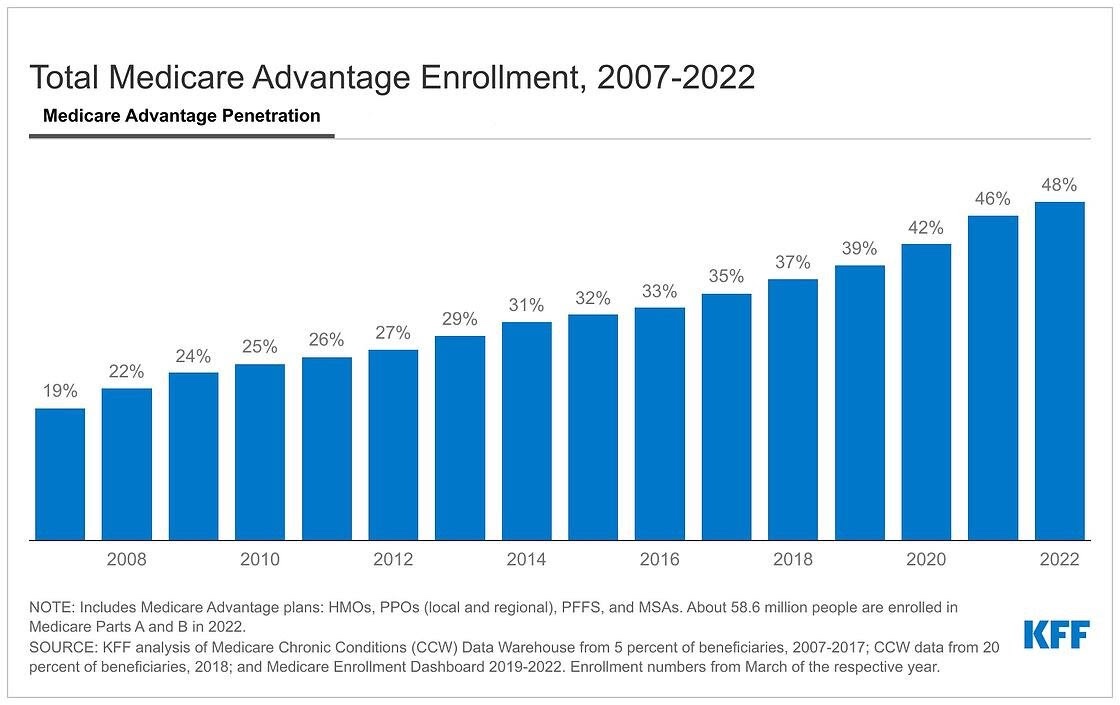
A new KFF analysis finds that nearly half of eligible Medicare beneficiaries – 28.4 million out of 58.6 million Medicare beneficiaries overall – are now enrolled in Medicare Advantage plans. That represents a more than doubling of the share of the eligible Medicare population enrolled in such plans from 2007 to 2022 (19% to 48%). Enrollment is projected to cross the 50 percent threshold as soon as next year, making Medicare Advantage the predominant way that Medicare beneficiaries with Parts A and B get their coverage and care.

Statutory and Plan-Bid Components of the Regional MA Benchmarks

Carriers set their actual prices by bidding against the capitation payment amounts. Carriers with plans that do well on Medicare Advantage program quality measures get a higher monthly capitation payment.

Statutory and Plan-Bid Components of the Regional MA Benchmarks

The annual election period for 2020 coverage is set to start Oct. 15 and run until Dec. 7. The capitation payment spreadsheet below shows about how much Medicare Advantage program managers think they should be paying each month for each Medicare Advantage plan enrollee’s care.

Carriers set their actual prices by bidding against the capitation payment amounts. Carriers with plans that do well on Medicare Advantage program quality measures get a higher monthly capitation payment.

  • The 2020 county-level averages range from $755 per month, in Presidio, Texas, up to $1,609, in Nome, Alaska.
  • To simplify things, we calculated state-level averages. The 2020 state-level averages ranged from $883 per month, in Hawaii, up to $1,168, in Alaska.
  • We also calculated how fast each state’s average capitation level changed between 2019 and 2020. The year-over-year change ranged from 4%, in Delaware, up to 8.2%, in one state.

ACCESS THE 2021 MEDICARE RATEBOOK: 2021 Medicare Ratebook (National, County Level Capitation Rates)

Determining Medicare payment for regional MA plans

Aside from a few special payment incentives, payment for regional MA plans is determined like payment for local plans, except that the benchmarks are calculated differently. CMS determines the benchmarks for the MA regional plans by using a more complicated formula that incorporates the plan bids. A region’s benchmark is a weighted average of the average county rate and the average plan bid.

As directed by law, CMS computes the average county rate as the individual county rates weighted by the number of Medicare beneficiaries who live in each county. The average plan bid is each plan’s bid weighted by each plan’s projected number of enrollees. CMS then combines the average county rate and the average bid into an overall average. In calculating the overall average, the average bid is weighted by the number of enrollees in all private plans across the country, and the average county rate is weighted by the number of all Medicare beneficiaries who remain in FFS Medicare.

#CMS #FFS Medicare #Medicare #2021RateBook

Title 42. Public HealthChapter IV. CENTERS FOR MEDICARE & MEDICAID SERVICES, DEPARTMENT OF HEALTH AND HUMAN SERVICES Subchapter B. MEDICARE PROGRAM Part 422. MEDICARE ADVANTAGE PROGRAM Subpart F. Submission of Bids, Premiums, and Related Information and Plan Approval Section 422.258. Calculation of benchmarks.

Updates to UnitedHealthcare Cost-Share Waivers

To ensure members are able to access the care they need as the COVID-19 pandemic continues, UnitedHealthcare is expanding cost share waivers for our Medicare Advantage and Individual and Group Market health plans for certain services. Here’s a high-level

The following provides healthcare providers and patients with information surrounding cost-share (copays, etc.) and applicable policies as enacted by United Healthcare (UHC).

Not ALL patients covered by UHC are implicated — please read the line of business (Medicare, type of commercial insurance, etc.) before making potentially detrimental changes in your cost-share collections.

PRIMARY CARE PROVIDERS WITH UHC PATIENTS, NEW POLICIES APPLY TO YOU

To ensure members are able to access the care they need as the COVID-19 pandemic continues, UnitedHealthcare is expanding cost-share waivers for our Medicare Advantage and Individual and Group Market health plans for certain services. Here’s a high-level summary of the changes.

New! Medicare Advantage Primary Care
Care Oct. 1, 2020 through Dec. 31, 2020, UnitedHealthcare is waiving cost share for Medicare

New! Medicare Advantage Primary Care
From Oct. 1, 2020 through Dec. 31, 2020, UnitedHealthcare is waiving cost share for Medicare Advantage plan members for primary care professional services. This applies to in-network and covered out-of-network COVID-19 and non-COVID-19 visits, whether they are conducted in-office or via telehealth.

Telehealth Originating Site Requirements (no changes since 9/28/20)

Telehealth Originating Site Requirements (no changes since 9/28/20)

The updates to originating site requirements that we announced on Sept. 28, 2020 have not changed.

  • Individual and fully insured Group Market health plans:
    • For Individual and fully insured Group Market health plans, there are changes related to COVID-19 and non-COVID-19 telehealth visits, as well as for in- and out-of-network providers. You’ll also find state-specific rules, regulations and emergency periods on the State Provision Exception page. These may vary from federal regulations. If no state-specific exceptions apply, UnitedHealthcare guidelines will apply.
      • COVID-19 and non-COVID-19 in-network telehealth visits: The expansion of telehealth access is extended through Dec. 31, 2020.* This means health care professionals can temporarily provide telehealth services by a live interactive audio-video or audio-only communications system for members at home or another location. For more details on telehealth billing guidance and provider type eligibility, visit UHCprovider.com/covid19.
      • COVID-19 out-of-network telehealth visits: The expansion of telehealth access for out-of-network providers ends Oct. 22, 2020. As of Oct. 23, 2020, out-of-network telehealth services are covered according to the member’s benefit plan and UnitedHealthcare’s telehealth reimbursement policy.*
      • Non-COVID-19 out-of-network telehealth visits: The expansion of telehealth access for out-of-network providers ended July 24, 2020. As of July 25, 2020, out-of-network telehealth services are covered according to the member’s benefit plan and UnitedHealthcare’s telehealth reimbursement policy.

Medicare Advantage:

  • COVID-19 and non-COVID-19 in-network telehealth visits: The expansion of telehealth access is extended through Dec. 31, 2020. Any originating site requirements that apply under Original Medicare are temporarily waived, so that telehealth services provided through live interactive audio-video can be billed for members at home or another location.
  • COVID-19 and non-COVID-19 out-of-network telehealth visits: The expansion of telehealth access is extended through the national public health emergency period, currently scheduled to end Oct. 22, 2020.*
Medicare Advantage COVID-19 Treatment

Cost share waivers (copay, coinsurance and deductible) for COVID-19 testing and testing-related visits are extended through Dec. 31, 2020 for our Medicare Advantage health plans. This applies to in-network and covered out-of-network COVID-19 treatment.

COVID-19 Treatment

Individual and Group Market health plans:

Cost share waivers (copay, coinsurance and deductible) for in-network COVID-19 treatment are extended through Dec. 31, 2020. Out-of-network cost share waivers will end Oct. 22, 2020. Implementation for self-funded customers may vary.

Medicare Advantage:

Cost share waivers (copay, coinsurance and deductible) for COVID-19 treatment are extended through Dec. 31, 2020. This applies to in-network and covered out-of-network COVID-19 treatment.

COVID-19 and non-COVID-19 out-of-network telehealth visits:
  • Individual and fully insured Group Market health plans: For Individual and fully insured Group Market health plans, there are changes related to COVID-19 and non-COVID-19 telehealth visits, as well as for in- and out-of-network providers. You’ll also find state-specific rules, regulations and emergency periods on the State Provision Exception page. These may vary from federal regulations. If no state-specific exceptions apply, UnitedHealthcare guidelines will apply.
  • COVID-19 and non-COVID-19 in-network telehealth visits: The expansion of telehealth access is extended through Dec. 31, 2020.* This means health care professionals can temporarily provide telehealth services by a live interactive audio-video or audio-only communications system for members at home or another location. For more details on telehealth billing guidance and provider type eligibility, visit UHCprovider.com/covid19.
  • COVID-19 out-of-network telehealth visits: The expansion of telehealth access for out-of-network providers ends Oct. 22, 2020. As of Oct. 23, 2020, out-of-network telehealth services are covered according to the member’s benefit plan and UnitedHealthcare’s telehealth reimbursement policy.*
  • Non-COVID-19 out-of-network telehealth visits: The expansion of telehealth access for out-of-network providers ended July 24, 2020. As of July 25, 2020, out-of-network telehealth services are covered according to the member’s benefit plan and UnitedHealthcare’s telehealth reimbursement policy.

Medicare Advantage:

  • COVID-19 and non-COVID-19 in-network telehealth visits: The expansion of telehealth access is extended through Dec. 31, 2020. Any originating site requirements that apply under Original Medicare are temporarily waived, so that telehealth services provided through live interactive audio-video can be billed for members at home or another location.
  • COVID-19 and non-COVID-19 out-of-network telehealth visits: The expansion of telehealth access is extended through the national public health emergency period, currently scheduled to end Oct. 22, 2020.*

Strong Networks Begin with Strong Healthcare Provider Relationships

As Medicare Advantage plans already know, many factors go into building a robust CMS-compliant network. One focal point should be strong provider relationships. Carenodes is committed to cultivating long-lasting relationships with healthcare professionals, offices, facilities and systems.

Here’s why these partnerships matter:

  • Strong relationships don’t happen overnight. We’ve been committed to building provider relationships for 40 years. Our experience, combined with the ability to evolve in a fluctuating healthcare landscape, helps ensure we’re always bringing value to our provider relationships. Then providers bring value to the network.
  • A plan is never starting from scratch. We have contracts with more than one million providers. We begin with these practitioners when helping to build, supplement or expand a network.
  • Contracted providers can help a network go to market faster: By leveraging contracted providers, we can secure contracts quickly, efficiently and cost effectively, so your plan can get to market faster.
  • Providers know Carenodes. Because so many providers already work with us, they know how we work. They also know they have broader access to health care programs, giving them the incentive to participate in a network.
  • Carenodes knows providers. Just like providers know us, we know our participating practitioners. Our 130 network development professionals understand what providers want. They’re able to convey the benefits of participating in a network.
  • Contracted providers are in a better position to meet network requirements. Our contracted providers have credentials using guidelines that are prepared in consideration of the NCQA CR Standards and guidelines. They may already be compliant with Medicare Advantage requirements or may only need to amend their contracts.

A commitment to strong provider relationships is just one aspect of Carenodes’ Network-Based Services for Medicare Advantage Plans.