Major HHS Rule Change: Is Your Healthcare Practice at Risk of Losing Medicare Payments?

The latest HHS rule targets information blocking practices in healthcare, imposing penalties for non-compliance. Healthcare providers face increased scrutiny, financial impact, and reputational risk. To comply, they must strengthen compliance programs, conduct thorough staff training, assess health IT systems, and maintain detailed documentation. Legal challenges may arise following the Supreme Court’s decision.

Discover how the latest HHS rule on information blocking could impact your healthcare practice and Medicare payments. The new rule aims to address the barriers that prevent the secure exchange of electronic health information, ultimately enhancing patient access to their own health data.

By understanding the intricacies of this rule, healthcare professionals can proactively adapt their practices to ensure compliance, avoid potential penalties, and navigate any legal challenges that may arise.

Introduction

On June 24, 2024, the Department of Health and Human Services (HHS) released a groundbreaking final rule that could have significant implications for healthcare providers across the country. This new regulation, aimed at curbing information blocking practices as defined under the 21st Century Cures Act, establishes a stringent framework for penalizing providers found guilty of these practices. With the rule set to take effect soon, healthcare providers need to act quickly to ensure compliance and avoid potentially severe penalties.


What is Information Blocking?

Information blocking involves practices that interfere with the access, exchange, or use of electronic health information (EHI) and can hinder the seamless flow of information critical for patient care. This new rule targets such practices, ensuring that healthcare providers promote interoperability and share information as required.


Key Details of the New Rule

Implementation Date:

The rule will be effective 30 days after its publication in the Federal Register.

Authority and Purpose:

This rule exercises the Secretary’s authority under the 21st Century Cures Act (Cures Act) to establish disincentives for health care providers who engage in information blocking. Information blocking involves practices that providers knew were unreasonable and likely to interfere with access, exchange, or use of EHI.


Disincentives Outlined

Medicare Promoting Interoperability Program

Eligible Hospitals

A reduction in payment by three-quarters of the applicable percentage increase in the market basket update if the hospital fails to demonstrate meaningful EHR use.

Critical Access Hospitals (CAH)

Reduced payment to 100% of reasonable costs from 101% if they fail to meet meaningful EHR use requirements..

Merit-based Incentive Payment System (MIPS)

Eligible Clinicians and Group Practices

A zero score in the Promoting Interoperability performance category for those found guilty of information blocking.

Accountable Care Organization (ACO) – Medicare Shared Savings Program:

ACOs and Participants

Potential denial of participation for one year and other mitigating actions for those found guilty of information blocking.


Implications for Healthcare Providers

Increased Scrutiny:

Healthcare providers should prepare for heightened investigations and monitoring by the OIG regarding their information-sharing practices.

Financial Impact:

The penalties could result in substantial financial losses, particularly for providers who heavily rely on Medicare reimbursements.

Reputational Risk:

Public reporting of violations may damage the reputation of providers found guilty of information blocking.

Compliance Programs

Providers must strengthen their compliance programs to prevent information blocking practices.

Technology Assessment:

Providers should assess their health IT systems and practices to identify and address potential information blocking issues.

Documentation:

Maintaining thorough documentation of information-sharing practices will be crucial in defending against investigations.

Education and Training:

Comprehensive staff training is essential to ensure all team members understand the prohibitions and consequences of information blocking.


Practical Takeaways

This final rule marks a significant step in HHS’s efforts to enforce information blocking prohibitions and promote interoperability in the healthcare system. Healthcare providers, executives, and compliance professionals should:

  • Carefully review the rule’s provisions.
  • Take proactive steps to ensure compliance.
  • Stay informed about OIG’s investigative priorities and any further guidance from HHS.

Complementary Rules

HHS rule complements the OIG’s final rule from June 2023, which established penalties for other actors in the information blocking sphere, including health IT developers, health information exchanges, and health information networks. Violations by these entities can result in civil monetary penalties of up to $1 million per violation.


Potential Legal Challenges

In light of the Supreme Court’s decision in Loper Bright Enterprises v. Raimondo, which ended Chevron deference to federal agencies, there may be opportunities to challenge this final rule. Healthcare providers interested in exploring legal challenges should consult with legal counsel to discuss potential strategies and collective actions.


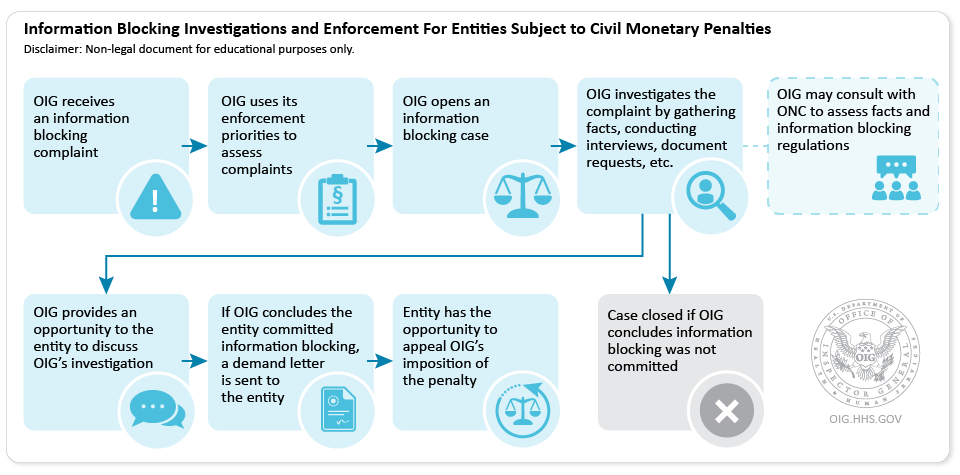
Information Blocking Investigations and Enforcement For Entities Subject to Civil Monetary Penalties

  1. OIG receives an information blocking complaint
  2. OIG uses its enforcement priorities to assess complaints
  3. OIG opens an information blocking case
  4. OIG investigates the complaint by gathering facts, conducting interviews, document requests, etc.
    1. OIG may consult with ONC to assess facts and information blocking regulations
    2. Case closed if OIG concludes information blocking was not committed
  5. OIG provides an opportunity to the entity to discuss OIG’s investigation
  6. If OIG concludes the entity committed information blocking, a demand letter is sent to the entity
  7. Entity has the opportunity to appeal OIG’s imposition of the penalty
Enforcement Priorities

OIG expects that it will receive more information blocking complaints than it can investigate. To triage allegations and allocate resources, OIG will use the following priorities to select cases for investigation:

  • Resulted in, is causing, or had the potential to cause patient harm
  • Significantly impacted a provider’s ability to care for patients
  • Was of long duration
  • Caused financial loss to Federal health care programs, or other government or private entities
  • Was performed with actual knowledge

For more detail on these priorities and OIG’s approach to enforcing information blocking penalties, please see the rule


Conclusion

The new HHS rule is a pivotal measure in enhancing interoperability and ensuring seamless information sharing in the healthcare system. Providers must adapt quickly, bolster their compliance efforts, and remain vigilant to navigate this evolving regulatory landscape effectively. Failure to comply could result in significant financial and reputational damage, making immediate action essential for all healthcare providers.


FAQs

What is the effective date of the new HHS rule on information blocking?

The rule will take effect 30 days after its publication in the Federal Register.

What penalties are outlined for hospitals under the new rule?

Eligible hospitals may face a reduction in payment by three-quarters of the applicable percentage increase in the market basket update if they fail to demonstrate meaningful EHR use.

How will the rule impact Critical Access Hospitals (CAH)?

CAHs will see a reduced payment to 100% of reasonable costs from 101% if they fail to meet meaningful EHR use requirements.

What are the consequences for MIPS eligible clinicians found guilty of information blocking?

Clinicians or group practices will receive a zero score in the Promoting Interoperability performance category.

How will the rule affect Accountable Care Organizations (ACO)?

ACOs or their participants found guilty of information blocking may face denial of participation for one year and other mitigating actions.

What should healthcare providers do to comply with the new rule?

Providers should strengthen compliance programs, conduct comprehensive staff training, assess health IT systems, and maintain thorough documentation of information-sharing practices.


Medicaid Coverage for Incarcerated Youth: California’s Initiative

What is the Justice-Involved Initiative?

The Justice-Involved Initiative is a pioneering program under California’s Medicaid reforms, specifically designed to extend Medicaid coverage to incarcerated individuals. Historically, under the Medicaid Inmate Payment Exclusion Rule, federal Medicaid funds could not be used to cover healthcare costs for inmates of public institutions, which includes youth detained in correctional facilities. However, through the Justice-Involved Initiative, California has become the first state to receive federal approval to offer a targeted set of community-based Medicaid services to Medi-Cal-eligible, incarcerated youth and adults for up to 90 days prior to their release.

Eligibility Criteria for Pre-Release Services

For incarcerated youth to receive pre-release services under the Justice-Involved Initiative, they must meet the following criteria:

  1. Medi-Cal or CHIP Eligibility: The youth must be eligible for either Medi-Cal or the Children’s Health Insurance Program (CHIP).
  2. Custody: They must be in the custody of a youth correctional facility.

Unlike adults, there are no specific health care criteria for youth to qualify for these services. However, adults must meet one or more of the following health care needs:

  • Mental illness
  • Substance use disorder
  • Chronic condition or significant non-chronic clinical condition
  • Intellectual or developmental disability
  • Traumatic brain injury
  • HIV/AIDS
  • Pregnant or postpartum

An important distinction in this program is that “youth” is determined by the correctional facility and not strictly by the individual’s age.

Available Pre-Release Services

The services available to incarcerated youth in the 90 days prior to their release include:

  • Reentry Care Management Services: Coordination of care to ensure a smooth transition back into the community.
  • Physical and Behavioral Health Clinical Consultation Services: Medical and mental health consultations to address immediate and ongoing health needs.
  • Laboratory and Radiology Services: Diagnostic tests and imaging.
  • Medications and Medication Administration: Access to necessary medications and management of medication regimens.
  • Medication Assisted Therapy (MAT): Includes counseling and support for substance use disorders.
  • Services by Community Health Workers (CHWs): Support from individuals with lived experience who can provide guidance and assistance.

Initiation of Pre-Release Services

The timing and initiation of these services depend on the length of stay and the anticipated release date of the incarcerated individual:

  • Short or Unknown Length of Stay: Services should begin as close to intake as possible, once the individual’s Justice-Involved aid code is activated.
  • Known Release Date (longer than 30 days stay): Services should commence within the 90-day period prior to their release.

Impact and Significance

The Justice-Involved Initiative represents a significant shift in how healthcare is provided to incarcerated populations, particularly youth. By extending Medicaid coverage to include pre-release services, California aims to improve health outcomes and facilitate a smoother transition back into the community. This initiative addresses the critical healthcare needs of incarcerated individuals, ensuring they receive necessary care before reentering society, which can help reduce recidivism and support overall public health.

Conclusion

California’s Justice-Involved Initiative is a groundbreaking effort to provide essential healthcare services to incarcerated youth and adults prior to their release. By ensuring these individuals receive the necessary medical, mental health, and support services, the initiative not only addresses immediate health needs but also supports their reintegration into the community. This innovative approach sets a precedent for other states to follow, aiming to enhance the well-being of justice-involved populations and promote more equitable healthcare access.

For more information, you can refer to detailed guidelines and policy documents provided by the Department of Health Care Services (DHCS).

  1. Congressional Research Service: Medicaid and Incarcerated Individuals
  2. CalAIM Behavioral Health Initiative Frequently Asked Questions
  3. Department of Health Care Services, Medi-Cal Managed Care Plans by County (2023 and 2024)
  4. Department of Health Care Services, Changes to Managed Care for the Child Welfare Population (April 2023)
  5. Department of Health Care Services, All Plan Letter No. 22-005: No Wrong Door Policy
  6. Department of Health Care Services, All Plan Letter No. 21-011 (Revised): Grievance and Appeals Processes
  7. Medi-Cal Manual for Intensive Care Coordination (ICC), Intensive Home Based Services (IHBS), and Therapeutic Foster Care (TFC) Services for Medi-Cal Beneficiaries
  8. Department of Health Care Services, Behavioral Health Information Notice No. 23-056: MOU Requirements for MHP and MCP
  9. Sample MOU Template

These resources provide detailed information about the Justice-Involved Initiative and related healthcare policies for justice-involved youth.

Statutory and Plan-Bid Components of the Regional MA Benchmarks

Carriers set their actual prices by bidding against the capitation payment amounts. Carriers with plans that do well on Medicare Advantage program quality measures get a higher monthly capitation payment.

Statutory and Plan-Bid Components of the Regional MA Benchmarks

The annual election period for 2020 coverage is set to start Oct. 15 and run until Dec. 7. The capitation payment spreadsheet below shows about how much Medicare Advantage program managers think they should be paying each month for each Medicare Advantage plan enrollee’s care.

Carriers set their actual prices by bidding against the capitation payment amounts. Carriers with plans that do well on Medicare Advantage program quality measures get a higher monthly capitation payment.

  • The 2020 county-level averages range from $755 per month, in Presidio, Texas, up to $1,609, in Nome, Alaska.
  • To simplify things, we calculated state-level averages. The 2020 state-level averages ranged from $883 per month, in Hawaii, up to $1,168, in Alaska.
  • We also calculated how fast each state’s average capitation level changed between 2019 and 2020. The year-over-year change ranged from 4%, in Delaware, up to 8.2%, in one state.

ACCESS THE 2021 MEDICARE RATEBOOK: 2021 Medicare Ratebook (National, County Level Capitation Rates)

Determining Medicare payment for regional MA plans

Aside from a few special payment incentives, payment for regional MA plans is determined like payment for local plans, except that the benchmarks are calculated differently. CMS determines the benchmarks for the MA regional plans by using a more complicated formula that incorporates the plan bids. A region’s benchmark is a weighted average of the average county rate and the average plan bid.

As directed by law, CMS computes the average county rate as the individual county rates weighted by the number of Medicare beneficiaries who live in each county. The average plan bid is each plan’s bid weighted by each plan’s projected number of enrollees. CMS then combines the average county rate and the average bid into an overall average. In calculating the overall average, the average bid is weighted by the number of enrollees in all private plans across the country, and the average county rate is weighted by the number of all Medicare beneficiaries who remain in FFS Medicare.

#CMS #FFS Medicare #Medicare #2021RateBook

Title 42. Public HealthChapter IV. CENTERS FOR MEDICARE & MEDICAID SERVICES, DEPARTMENT OF HEALTH AND HUMAN SERVICES Subchapter B. MEDICARE PROGRAM Part 422. MEDICARE ADVANTAGE PROGRAM Subpart F. Submission of Bids, Premiums, and Related Information and Plan Approval Section 422.258. Calculation of benchmarks.