The 2025 Healthcare Perfect Storm: How Rising Costs and Increased Scrutiny Impact Insurers

The blog post examines the health insurance industry’s challenges in 2025, highlighting rising healthcare costs, increased patient demand, and heightened government scrutiny. Insurers, particularly those focused on Medicare Advantage, must reevaluate strategies to maintain profitability. Despite these hurdles, opportunities for innovation and growth exist through personalized care and strategic partnerships.

This blog post delves into the complex challenges facing the health insurance industry in 2025, a year poised to be a pivotal moment for insurers, particularly those heavily invested in Medicare Advantage plans. Rising healthcare costs, increased patient demand, and heightened government scrutiny are converging to create what we’re calling a “perfect storm.” This confluence of factors threatens profitability and necessitates a critical reevaluation of existing operational strategies. This post expands on the themes discussed in our latest podcast episode, exploring these challenges in greater depth and offering insights into potential solutions for both insurers and healthcare providers.

Rising Healthcare Costs: A Looming Crisis

The escalating cost of healthcare is arguably the most significant challenge facing insurers. Inflation, technological advancements, and the increasing complexity of medical treatments all contribute to this unsustainable upward trend. The post-COVID surge in patient utilization, with many seeking deferred procedures, has exacerbated the problem, placing immense pressure on insurers’ financial reserves. This increased demand is straining existing resources and impacting profitability, pushing medical loss ratios (MLRs) higher than ever before. The implications are profound, forcing insurers to re-evaluate pricing strategies, negotiate more effectively with providers, and explore innovative cost-containment measures.

The Impact on Medicare Advantage

Medicare Advantage (MA) plans, once considered a goldmine for insurers, are particularly vulnerable in this environment. The increased demand for MA plans, coupled with rising healthcare costs, is squeezing profit margins. Major players like Humana and UnitedHealth Group, heavily reliant on MA for revenue, are grappling with these challenges head-on. Their financial performance is becoming increasingly dependent on their ability to manage costs efficiently while maintaining patient satisfaction and adherence to regulatory requirements.

Increased Patient Demand: A Double-Edged Sword

While increased patient demand initially appears beneficial, in the context of rising costs, it becomes a major challenge. Insurers are faced with a difficult balancing act: fulfilling the needs of a growing patient population while simultaneously controlling costs and maintaining profitability. This necessitates a shift towards more proactive and personalized care models that prioritize preventative measures and disease management. Strategic partnerships with providers are crucial for achieving these goals.

The Need for Personalized Care

The sheer volume of patients requires a move beyond traditional, reactive models of care. Personalized care, driven by data analysis and predictive modeling, is becoming essential for identifying high-risk individuals and implementing targeted interventions. This approach not only improves patient outcomes but also helps to manage healthcare costs more effectively, ultimately impacting the MLR and safeguarding insurer profitability.

Increased Government Scrutiny: Navigating Regulatory Hurdles

The health insurance industry is facing unprecedented levels of government scrutiny. Lawmakers are increasingly focused on issues of transparency, affordability, and access to care. This heightened scrutiny translates into stricter regulations, increased audits, and potential penalties for non-compliance. Insurers must navigate this complex regulatory landscape while ensuring they maintain ethical and transparent practices.

Adapting to Regulatory Changes

The regulatory environment is constantly evolving, requiring insurers to be adaptable and proactive. Staying informed about new regulations, investing in compliance programs, and engaging with policymakers are crucial for navigating this challenging landscape. Failure to adapt could lead to significant financial penalties and reputational damage.

Opportunities Amidst the Storm

While the challenges are significant, the current climate also presents opportunities for innovation and growth. Entrepreneurs and healthcare providers can leverage this disruption by focusing on high-cost patient areas and developing innovative solutions that improve efficiency and reduce waste within the healthcare system. New models of care, such as value-based care, offer potential avenues for both improved patient outcomes and reduced costs.

Innovation in Healthcare Delivery

The need for cost-effective and efficient healthcare delivery models has never been greater. Entrepreneurs are stepping up to the plate, developing innovative technologies and solutions to address these challenges. These range from telehealth platforms and remote monitoring devices to AI-powered diagnostic tools and personalized treatment plans. Insurers that embrace these innovations and forge strategic partnerships with these innovators will be better positioned to thrive in the evolving healthcare landscape.

Conclusion

The healthcare industry in 2025 faces a perfect storm of rising costs, increasing patient demand, and intensified regulatory scrutiny. Insurers, especially those heavily reliant on Medicare Advantage, are experiencing significant financial pressure. This necessitates a complete re-evaluation of operational strategies, focusing on cost containment, personalized care, and proactive compliance. However, amidst these challenges lie significant opportunities for innovation and growth. By embracing new technologies, fostering strategic partnerships, and prioritizing patient-centric care models, both insurers and healthcare providers can navigate this turbulent environment and emerge stronger. To delve deeper into this topic and explore potential opportunities, please listen to our podcast episode, “2025 Opportunities in Healthcare: Navigating the Perfect Storm.” This episode provides further insights into the challenges and opportunities discussed in this blog post and offers actionable strategies for navigating the complexities of the 2025 healthcare landscape.

Companies mentioned in this episode:

Research Links:

The Definitive Playbook for Choosing Behavioral Health Markets Value Based Care Advisory (VBCA) Podcast

Rate sheets don't tell the whole story.In this episode, Alex Yarijanian breaks down the 8-indicator playbook he uses to evaluate any tele-behavioral health market before committing capital — and names the specific states he'd enter today and why.Most operators default to the biggest states: California, Texas, Florida, New York. But population size alone is one of the weakest predictors of a winning market. The real levers live in parity law enforcement, workforce economics, MCO concentration, and infrastructure readiness.WHAT YOU'LL LEARNWhy the biggest states are rarely the best markets for tele-behavioral healthThe 8 indicators that separate win-win markets from cheap-rate miragesHow to build a weighted scoring model before entering a new marketWhat associate-level billing eligibility does to your workforce marginsHow MCO concentration affects contracting speed and rate-cut riskWhich states Alex rates as best all-around, high-risk, and growth-stage betsTHE 8 MARKET INDICATORSMedicaid market size: Total addressable population and realistic capture potentialPayment parity: State-level mental health parity laws and strength of enforcementCost of living index: The single best proxy for labor margin on clinical staffAssociate-level billing: Whether licensed associates can bill independentlyHRSA HPSA demand mapping: Documented unmet need in mental health shortage areasBroadband & 5G coverage: Infrastructure required for reliable telehealth deliveryMCO landscape: Plan count, behavioral carve-outs, any-willing-provider law exposureTax & corporate climate: State-level business environment and regulatory postureMARKET ARCHETYPESBest all-around: Arizona, Nebraska, Delaware, OregonVolume, thin margins: Arkansas, North DakotaHigh rate, high cost niche: AlaskaGrowth stage bets: New Mexico, Montana4 ACTION STEPSBuild a scroll scoring model — layer all 8 indicators into a weighted scorecardValidate demand on the ground — overlay HRSA HPSA maps + FCC broadband gap dataCheck your plan mix — count Medicaid MCOs and behavioral carve-outsRun a payroll stress test — model cost of living vs. your target clinician pay bandRESOURCES MENTIONED HRSA Mental Health HPSA maps: data.hrsa.govFCC broadband coverage maps: broadbandmap.fcc.govNCSL mental health parity law trackerLicensure compact maps: PSYPACT, ASWB Compact, Nurse Licensure Compact State Medicaid rate databases
  1. The Definitive Playbook for Choosing Behavioral Health Markets
  2. Medicare Negotiates Like an Owner. Commercial Doesn’t.
  3. The Rural Health Transformation Fund: What States Are Funding in 2026
  4. Medicare Advantage 2026: How Payers Are Choosing Partners
  5. Digital Health at a Crossroads: The Fallout from a $100M Adderall Fraud Scheme
Unlock Financial Success with CalAIM: Budget Estimator Tool for CBOs

The CalAIM Budget Estimator Tool helps CBOs navigate the financial complexities of contracting under CalAIM. It offers an Excel-based template with built-in assumptions, cost input fields, revenue customization, and a summary tab. The tool supports informed decision-making, negotiation power, and sustainability, empowering organizations to enhance care and expand services.

Introduction

Navigating the financial complexities of contracting under the California Advancing and Innovating Medi-Cal (CalAIM) initiative can be challenging for community-based organizations (CBOs). With new Medi-Cal benefits such as Enhanced Care Management and Community Supports, understanding potential revenue and expenses is crucial. This is where the CalAIM Budget Estimator Tool comes in, offering a robust template to help CBOs project financial viability and ensure their mission’s sustainability.

Understanding the CalAIM Budget Estimator Tool

CalAIM Budget Estimator Tool: The CalAIM Budget Estimator Tool is an Excel-based template designed to help organizations estimate costs and potential revenue from providing Medi-Cal Enhanced Care Management and selected Community Support Services. These services include housing-related services and medically tailored meals.

Key Features

  • Built-in Assumptions: The tool incorporates assumptions about payment structures for these services, as outlined in the California Department of Health Care Services CALAIM Enhanced Care Management Policy Guide and Community Supports Policy Guide.
  • Cost Input: Users can enter organization-specific expenses such as staffing costs and other direct and indirect costs.
  • Revenue Customization: It includes generic rate ranges and areas for customizing expected revenue sources to calculate the program margin (ratio of revenue to expenses).
  • Summary Tab: A summary tab displays the projected margin by program year, helping users understand if their assumptions lead to a fiscally viable program.

The Importance of Financial Viability for CBOs

For CBOs, financial viability is paramount. The adage “No margin, no mission” rings true as these organizations aim to enhance services for individuals with complex health and social needs. The CalAIM Budget Estimator Tool enables organizations to model various scenarios for their programs, supporting meaningful feasibility discussions with financial officers and other decision-makers.

How the CalAIM Budget Estimator Tool Supports CBOs

The CalAIM Budget Estimator Tool is designed to facilitate informed discussions about future programming and the financial feasibility of providing new Medi-Cal services. Here’s how it supports CBOs:

  • Modeling Various Scenarios: The tool allows organizations to create multiple financial scenarios, enabling a comprehensive understanding of different potential outcomes.
  • Justifying Rate Requests: By organizing and highlighting critical financial information, the tool helps CBOs justify rate requests to MCOs during contract negotiations.
  • Enhancing Financial Confidence: With detailed projections, CBOs can confidently navigate the financial aspects of contracting with MCOs.

Step-by-Step Guide to Using the CalAIM Budget Estimator Tool

Step 1: Download the Tool

Step 2: Enter Costs

  • Input your organization-specific expenses, including staffing costs and other direct and indirect costs.

Step 3: Customize Revenue Sources

  • Use the tool to enter expected revenue sources. Customize the rates to reflect realistic projections for your organization.

Step 4: Review Summary Tab

  • Examine the summary tab to view the projected margin by program year. This will help you understand the financial viability of your program.

Benefits of Using the CalAIM Budget Estimator Tool

Informed Decision-Making: The tool provides comprehensive data to support strategic financial decisions. Enhanced Negotiation Power: With detailed financial projections, CBOs can negotiate better rates with MCOs. Sustainability: Ensuring financial viability helps CBOs sustain their mission and expand services under CalAIM.

Frequently Asked Questions

What is the CalAIM Budget Estimator Tool? The CalAIM Budget Estimator Tool is an Excel-based template designed to help organizations estimate costs and potential revenue from providing Medi-Cal Enhanced Care Management and selected Community Support Services.

How does the tool support CBOs in contracting with MCOs? The tool enables CBOs to model various financial scenarios, justify rate requests during negotiations, and make informed decisions about program viability.

What are the key features of the CalAIM Budget Estimator Tool? Key features include built-in assumptions, cost input fields, revenue customization, and a summary tab displaying projected margins.

Can the tool be customized for specific organizational needs? Yes, users can customize expense inputs and revenue projections to reflect their specific organizational needs.

How do I get started with the CalAIM Budget Estimator Tool? Download the tool, enter your organization-specific costs, customize revenue sources, and review the summary tab to understand financial projections.

Why is financial viability important for CBOs? Financial viability ensures that CBOs can sustain their mission and expand services, ultimately enhancing care for individuals with complex health and social needs.

Conclusion

The CalAIM Budget Estimator Tool is an invaluable resource for CBOs looking to contract with managed care organizations under CalAIM. By providing detailed financial projections, the tool empowers organizations to make informed decisions, justify rate requests, and ensure the sustainability of their mission. Download the tool today and take the first step towards financial success and enhanced service offerings.

Understanding State-Level Variation in Medicaid Managed Care Maternity Kick Payments

Understanding State-Level Variation in Supplemental Maternity Kick Payments in Medicaid Managed Care


Introduction

Today, we’re exploring an intriguing study on the state-level variation in supplemental maternity kick payments in Medicaid managed care. This study, conducted by Samantha G. Auty, Jamie R. Daw, and Jacob Wallace, provides valuable insights into how these payments impact delivery costs and care quality.


Post Introduction

In this post, we’ll break down the key findings of the study, understand the implications of kick payments on Medicaid managed care, and discuss how these variations can affect maternal health outcomes across different states. Let’s get started by understanding the basics of Medicaid managed care and why kick payments are essential.


Detailed Story

What is Medicaid Managed Care?

Medicaid managed care (MMC) involves states contracting with private health insurers to provide Medicaid coverage. This model covers about 70% of pregnant Medicaid enrollees and finances approximately 41% of all births in the United States. Under MMC, insurers receive per-member-per-month capitated payments to cover a defined set of benefits. However, covering pregnant individuals poses a higher financial risk due to their increased healthcare needs, which often leads to states implementing one-time “kick payments” to MMC plans triggered by delivery events.

The Role and Variation of Kick Payments

Kick payments are designed to offset the higher costs associated with childbirth. The rates and use of these payments can significantly influence whether MMC plans are incentivized to attract or avoid pregnant enrollees. This study aimed to assess the prevalence and magnitude of these kick payments across different states and how they align with actual delivery costs.

Research Methodology

The researchers conducted a cross-sectional study, abstracting data from state documents and MMC contracts published between 2018 and 2020. They gathered information on whether states used kick payments, the services covered by these payments, and the specific rates.

Additionally, they compared these rates with average state Medicaid fee-for-service (FFS) payments for delivery hospitalizations in 2020 and the Medicaid-Medicare fee index.

Key Findings

The study revealed that out of the 38 states and the District of Columbia using comprehensive MMC, 33 states used maternity kick payments. These payments varied significantly, ranging from $2,838 in New Hampshire to $14,493 in Maryland. Interestingly, the variation in kick payment rates did not correlate with the Medicaid payments to physicians or the actual delivery costs, indicating that in some states, kick payments might exceed delivery costs, while in others, they fall short.

These payments varied significantly, ranging from $2,838 in New Hampshire to $14,493 in Maryland.


Expert Insights

To further explore the implications of these findings, let’s delve into some expert insights.

Potential Implications of Low Kick Payment Rates

When kick payment rates are set too low, MMC plans might attempt to limit services for pregnant enrollees or restrict access to maternity care providers. This can lead to disparities in care quality and access, particularly affecting Black and Indigenous women, who are disproportionately enrolled in Medicaid and face higher risks of maternal mortality and morbidity.

The Need for Aligned Incentives

Aligning kick payment rates with actual delivery costs and care quality is crucial. States need to design Medicaid payment policies that support maternal health and promote health equity. This requires continuous research to understand the effects of these payments on care access, quality, and outcomes.


In-Depth Analysis

The Study’s Limitations

While the study provides valuable insights, it has some limitations. It could not directly associate kick payment rates with MMC plan behavior or maternal health outcomes. Additionally, the comparison was made with Medicaid FFS payments rather than the prices MMC plans paid for delivery services, which were unavailable.

The Path Forward

Further research is essential to evaluate the impact of kick payments on maternal care access and outcomes. Policymakers need comprehensive data to design effective Medicaid payment strategies that ensure equitable and high-quality maternal care.


Practical Tips

For state policymakers and healthcare administrators:

  1. Regular Review of Kick Payment Rates: Ensure that kick payment rates are regularly reviewed and adjusted to reflect actual delivery costs and care quality needs.
  2. Focus on Health Equity: Design payment policies that address disparities in maternal health outcomes, particularly for vulnerable populations.
  3. Data-Driven Decision Making: Use comprehensive data to evaluate the impact of payment policies on maternal care access and outcomes.

FAQ Section

Q1: What are Medicaid managed care kick payments? A: Kick payments are one-time payments made to Medicaid managed care plans to offset the higher costs associated with childbirth.

Q2: Why do kick payment rates vary between states? A: The variation can be due to different state policies, healthcare costs, and the structure of Medicaid managed care contracts.

Q3: How can low kick payment rates affect maternity care? A: Low rates can lead to MMC plans limiting services for pregnant enrollees or restricting access to maternity care providers, affecting care quality and access.

Q4: What can states do to improve kick payment policies? A: States should regularly review and adjust kick payment rates, focus on health equity, and use data-driven approaches to design effective payment policies.


Source

State-Level Variation in Supplemental Maternity Kick Payments in Medicaid Managed Care

Introducing the Care MAP Tool: A Comprehensive Guide

Introducing the Care MAP Tool, designed to support healthcare providers in managing complex care needs. This user-friendly, Excel-based tool offers a structured framework for effective care coordination, resource allocation, and patient management. With modules for an overview and practical scenarios, plus a comprehensive resource library and FAQ section, the Care MAP Tool enhances care strategies and improves patient outcomes. Download it today and elevate your care management practices.

Effective care management is crucial in today’s complex healthcare landscape. To support healthcare professionals and organizations, we are excited to introduce the Care MAP Tool, a valuable resource designed to aid in complex care management. This blog will provide an overview of the Care MAP Tool, walk you through an example scenario, and offer access to a resource library and frequently asked questions (FAQ) section.

Module 1: Care MAP Overview

The Care MAP (Management and Planning) Tool is designed to support healthcare providers in managing and planning care for patients with complex health needs. This tool provides a structured framework to help clinics navigate the intricacies of care coordination, resource allocation, and patient management. Here’s what you can expect from the Care MAP Tool:

  • Framework for Complex Care Management: The tool offers a comprehensive structure to address the multifaceted needs of patients requiring intensive care management.
  • User-Friendly Interface: The Excel-based tool is intuitive and easy to navigate, ensuring that healthcare providers can quickly integrate it into their workflows.
  • Scalable and Adaptable: Whether you’re a small clinic or a large healthcare organization, the Care MAP Tool can be scaled and adapted to fit your unique needs.

Module 2: Example Scenario

To illustrate the practical application of the Care MAP Tool, let’s walk through an example scenario:

Scenario: Managing a Patient with Multiple Chronic Conditions

  1. Patient Overview:
    • Name: Jane Doe
    • Age: 65
    • Conditions: Diabetes, Hypertension, Chronic Obstructive Pulmonary Disease (COPD)
  2. Initial Assessment:
    • Medical History Review: Gather comprehensive information about Jane’s medical history, including past treatments, hospitalizations, and medications.
    • Social Determinants of Health: Assess factors such as living conditions, access to transportation, and social support.
  3. Care Coordination:
    • Interdisciplinary Team: Form a care team that includes primary care physicians, specialists, nurses, social workers, and community health workers.
    • Care Plan Development: Create a personalized care plan that addresses Jane’s medical and social needs, with clear goals and timelines.
  4. Monitoring and Evaluation:
    • Regular Check-ins: Schedule regular appointments and follow-ups to monitor Jane’s progress.
    • Adjustments: Modify the care plan as needed based on Jane’s response to treatment and changes in her condition.

Resource Library

The Resource Library is a curated collection of materials to further support your use of the Care MAP Tool. Here, you’ll find:

  • Guides and Manuals: Detailed instructions on how to use the Care MAP Tool effectively.
  • Case Studies: Real-world examples of the tool in action, showcasing its impact on patient outcomes.
  • Training Videos: Step-by-step video tutorials to help you and your team get up to speed quickly.

FAQ

To ensure you have all the information you need, we’ve compiled a list of frequently asked questions:

Q1: Who can use the Care MAP Tool?
A1: The tool is designed for healthcare providers, including clinicians, care coordinators, and administrative staff.

Q2: Is there a cost associated with the Care MAP Tool?
A2: No, the Care MAP Tool is available for free download.

Q3: How do I get support if I encounter issues with the tool?
A3: Support is available through our online helpdesk. You can also refer to the Resource Library for troubleshooting guides.

Care MAP Tool Download

By using the Care MAP Tool, you acknowledge that you have read and agree to the disclaimer below. If you share the tool, ensure that all individuals given access to it have reviewed and agreed to the disclaimer language before using it for any purpose.

Disclaimer: The Care MAP Tool is intended as a general framework to support considerations around complex care management in a clinic setting. It is not meant for final staffing, clinical, administrative, operational, and/or financial decision-making. Information obtained from this tool is not and should not be taken as legal or financial advice and is not a substitute for consulting a qualified professional. Community Initiatives does not accept responsibility for any loss that may arise from reliance on this tool.

Source Link:

Download Materials:


Feel free to reach out with any questions or feedback about the Care MAP Tool. Happy planning!

Medi-Cal Managed Care Quality Improvement Reports (CA)

Various reports from the State of California regarding the quality of care provided by Medi-Cal managed care health plans. Plan-specific evaluation reports are also prepared for each individual health plan reviewed.

The California Department of Health Care Services contracts with an external quality review organization to evaluate the care provided to Medi-Cal managed care beneficiaries in the areas of quality, access, and timeliness. Reports are available on the DHCS website, including member satisfaction surveys, encounter data validation study reports, managed care accountability sets, external quality review technical reports, plan-specific evaluation reports, health disparity reports, HEDIS® reports, MCP-specific performance evaluation reports, performance improvement project reports, and preventive services reports.

Outline

  • Introduction: Purpose of the DHCS external quality review organization
  • Available Reports:
    • Member Satisfaction Surveys
    • Encounter Data Validation Study Reports
    • Managed Care Accountability Sets/External Accountability Sets
    • External Quality Review Technical Reports and Plan-Specific Evaluation Reports
    • Health Disparity Reports
    • HEDIS® Reports
    • MCP-Specific Performance Evaluation Reports
    • Performance Improvement Project Reports
    • Preventive Services Report
  • Conclusion: Summary of available reports and their purpose.

In accordance with federal requirements, the California Department of Health Care Services (DHCS) contracts with an external quality review organization (EQRO) to conduct external quality reviews and evaluate the care provided to beneficiaries by Medi-Cal managed care health plans (MCPs) in the areas of quality, access, and timeliness. The EQRO presents these external quality review activities, results, and assessments in reports that help DHCS and Medi-Cal MCPs understand where to focus resources to further improve the quality of care.

Medi-Cal Managed Care Quality Strategy Reports

The Medi-Cal Managed Care Quality Strategy Reports are DHCS’ written strategy for assessing and improving the quality of managed care services offered by all Medi-Cal MCPs.

Member Satisfaction Surveys (CAHPS® Surveys)

Each Consumer Assessment of Healthcare Providers and Systems (CAHPS®) survey report aggregates the results of CAHPS® surveys, which ask Medi-Cal managed care beneficiaries to evaluate their experiences with their health care health care providers.

Encounter Data Validation Study Reports

Encounter Data Validation (EDV) Study Reports examine the completeness and accuracy of the encounter data submitted to DHCS by the MCPs.

Managed Care Accountability Sets / External Accountability Sets

The Managed Care Accountability Sets (MCAS) / External Accountability Set (EAS) is a set of performance measures that DHCS selects for annual reporting by Medi-Cal MCPs.

External Quality Review Technical Reports and Plan-Specific Evaluation Reports

The EQRO annually prepares an independent external quality review technical report that analyzes and evaluates aggregated information on the health care services provided by Medi-Cal MCPs. As part of the external quality review technical report, the EQRO prepares a plan-specific evaluation report of each of MCP.

Access these reports on the Medi-Cal Managed Care External Quality Review Technical Reports with Plan-Specific Evaluation Reports.

Health Disparity Reports

The Health Disparity Reports identify and understand health disparities affecting California’s Medi-Cal managed care members and are based on focused studies conducted annually by the EQRO. The reports analyze Managed Care Accountability Set (MCAS) measure results reported by Medi-Cal managed care plans (MCPs) for various demographic categories.

HEDIS® Reports

The Healthcare Effectiveness Data and Information Set (HEDIS®) Aggregate Report, also referred to as Performance Measurement Reports, provides performance rates of MCPs during a reporting year and trending using previous years’ data. The report also compares plan-specific and aggregated rates to national benchmarks.

MCP-Specific Performance Evaluation Reports

The MCP-Specific Performance Evaluation Reports are also referred to as Plan-Specific Performance Evaluation Reports.

Access these reports on the Medi-Cal Managed Care Quality Improvement Reports webpage

Performance Measures and HEDIS® Reports

Access Medi-Cal Managed Care’s annual performance measure, External Accountability Set, on the Medi-Cal Managed Care Quality Improvement Reports webpage.

The following performance measure results are also available on our website:

Performance Improvement Project Reports

Plan-Specific Performance Evaluation Reports

Plan-Specific Performance Evaluation Reports are also referred to as MCP-Specific Performance Evaluation Reports.

Access the reports on the  Medi-Cal Managed Care Quality Improvement Reports: External Quality Review Technical Reports and Plan-Specific Evaluation Reports.

Quality Improvement Project Reports

Quality Improvement Project (QIP) Reports are available on the Medi-Cal Managed Care Quality Improvement Reports: Quality Improvement Project Reports webpage.

Technical Reports

Technical Reports are available on the Medi-Cal Managed Care Quality Improvement Reports: External Quality Review Technical Reports webpage.

Preventive Services Report

The 2021 Preventive Services Report and Executive Summary assist with identifying and monitoring appropriate utilization of preventive services for children in Medi-Cal Managed Care.

The 2020 Preventive Services Report and Addendum assesses the provision of preventive services by pediatric Medi-Cal managed care members.

Thoughts from Alex Yarijanian and Carenodes outcomes

Healthcare Startups take too long to go to market hence innovations do not get to the American people in a form and fashion conducive to the aims of healthcare quality and performance in population health management.
When I left my management role at Humana to enter into the startup world, I was shocked to find that a vast majority of Health Tech organizations are founded by innovators with non-healthcare backgrounds.

Healthcare Startups take too long to go to market hence innovations do not get to the American people in a form and fashion conducive to the aims of healthcare quality and performance in population health management.

When I left my management role at Humana to enter into the startup world, I was shocked to find that a vast majority of Health Tech organizations are founded by innovators with non-healthcare backgrounds.

I found that, in my conversations with startup leaders, they were overconfident and naive about the industry; about the many roadblocks and nuances of running a successful healthcare operation (ie. ‘Regulation Nation’, business complexity, and long ‘sales’ cycles become blockers to market entry).

Sadly and ultimately, this dynamic ‘kills’ otherwise life-changing innovations. We find this to be unfair. Not only to the startup but to the People. To you, Don. To me and my loved ones. These incredible inventions and ‘innovations’: dead on arrival; attributable to the founders’ lack of healthcare business navigational competency and expertise.

Educating the leaders was my first instinct (see me in action: Managed Care 101: Boot-camp for Healthcare Entrepreneurs).

Then, Carenodes Accelerator was born: a program along with outcomes not seen in the country. Programmatically, we provide an integrated suite of advisory, technological, data, clinical, and operational capabilities to ‘jumpstart’, or power, the startup on day 1.

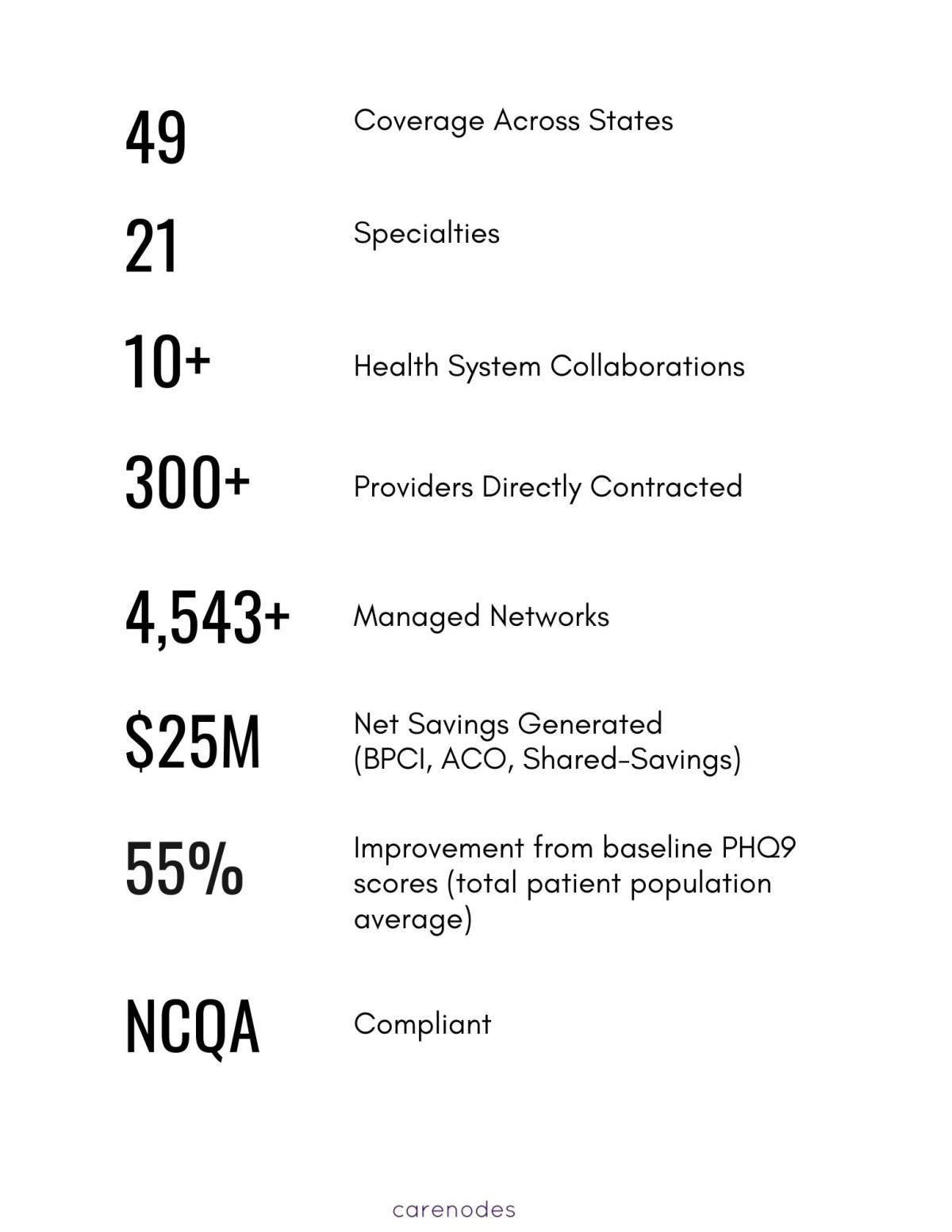
We signed our first health technology startup in August 2020. Today, Carenodes has grown to 7 portfolio digital health startups. We are 100% fiscally self-sustained, fully bootstrapped, and led by a majority ‘minority’ team. Our leadership and downstream team composition is what the ‘equity and diversity’ movements of modern-day fantasize about.

As of the time of this correspondence, our startup medical groups have raised an aggregate of $210M in funding.

We have, in aggregate, provided 96,637 appointments to 36,718 patients (2019 – 2022) in 50 states + DC. We have accelerated Digital healthcare innovations to a scale now reaching 48 million Americans.

Net result on the US Healthcare System is: Access. Access for Payer, Provider & Patient. Not just one of these ‘nodes’ — but all.

By becoming ‘in-network’, the out-of-pocket burden for offerings based on ‘cash only’ direct-to-consumer strategies is reduced tremendously making it affordable for the consumer. At the same time, our digital health organizations generate (much) greater revenue by billing insurance and coordinating care in a way that is not incentivized in a cash-only model. Our medical group startups generate revenues in 6 months via health insurance network participation.

We provide a robust operation with clinical oversight beyond just ‘being an app’ on a cash model. Payers feel more comfortable with that type of organization. Hospitals and health systems trust the expertise and buy-in. Especially since insurance will be paying for the services.

This has benefited the startup, the patient, the payer, and us — the regular folks who NEED access.

What is our impact? See the following outcomes and have these figures speak for themselves:

Carenodes real-world implications and outcomes (from Oct 1, 2019 – Jan 1, 2022):

  • Using patented IoT-connected socks, we avoid 91% of all diabetic foot ulcer amputations.
  • Using FDA-approved AI technology, we monitor the hearts of CHF/HF (heart failure) patients at home and at skilled nursing facilities in NY and CA. Diverting 75% of avoidable ER utilization.
  • Using our 24/7 access to care platform, we have provided 66,467 virtual opioid use disorder treatment appointments.
  • Using our Biopsychosocial Network, we extend a highly coordinated ‘plug & play’ provider network of 134 health providers (and growing) to help ease the major challenges of workforce supply, recruitment, and management.
  • In connection with UCI and other major health systems, we are one of the very few delivery organizations providing Hospital at Home.
  • We have, in aggregate, provided 96,637 appointments to 36,718 patients (2019 – 2022) in 50 states + DC. We have accelerated Digital healthcare innovations to a scale now reaching 48 million Americans.

Here is a one-minute video update of our organizational position opening in the year 2022 (this clip is not made searchable on YouTube, but you should have access with the link).

Medicaid MCO Quality Ratings

https://www.kff.org/medicaid/state-indicator/medicaid-mco-quality-ratings/view/print/?currentTimeframe=0&print=true&sortModel=%7B%22colId%22:%22State%22,%22sort%22:%22asc%22%7D

NOTES

Notes

Data reflect NCQA’s 2019 ratings of Medicaid managed care plans. The plans included in the NCQA data do not always match the MCOs in other tables in the Medicaid Managed Care Market Tracker, or they may appear under different names. Discrepancies may be due to differences across reports and sources, timeframes, and other factors. MCOs not accredited or rated by NCQA may be accredited or rated by other organizations.

The NCQA plan overall rating scale is 0-5 (0 is lower performance, 5 is higher performance). NCQA accreditation is as of June 30, 2018. For more information about how NCQA rates plans, please see NCQA’s methodology.

Sources

NCQA Health Insurance Plan Ratings 2018-2019 – Summary Report (Medicaid). Special Data Request, October 2019.

Definitions

Partial Data Reported: Plans with partial data do not receive a rating, but NCQA lists them in the ratings and shows their scores on the measures they report. A plan is considered to have partial data if it submits HEDIS and CAHPS measure data for public reporting, but has insufficient data for one or more measures, submits HEDIS data for public reporting but does not submit CAHPS data, or vice versa, or earned NCQA Accreditation without HEDIS data (health plan accreditation standards only) and did not submit HEDIS or CAHPS data for public reporting.

No Data Reported: Plans that submit results but do not report data publicly, or plans that report no HEDIS, CAHPS or accreditation information to NCQA, are given a rating status of “No Data Reported”.

Insufficient Data: Plan has “missing values” (i.e., NA or NB) in more than 50 percent of the weight of the measures used in the methodology.