The 2025 Healthcare Perfect Storm: How Rising Costs and Increased Scrutiny Impact Insurers

The blog post examines the health insurance industry’s challenges in 2025, highlighting rising healthcare costs, increased patient demand, and heightened government scrutiny. Insurers, particularly those focused on Medicare Advantage, must reevaluate strategies to maintain profitability. Despite these hurdles, opportunities for innovation and growth exist through personalized care and strategic partnerships.

This blog post delves into the complex challenges facing the health insurance industry in 2025, a year poised to be a pivotal moment for insurers, particularly those heavily invested in Medicare Advantage plans. Rising healthcare costs, increased patient demand, and heightened government scrutiny are converging to create what we’re calling a “perfect storm.” This confluence of factors threatens profitability and necessitates a critical reevaluation of existing operational strategies. This post expands on the themes discussed in our latest podcast episode, exploring these challenges in greater depth and offering insights into potential solutions for both insurers and healthcare providers.

Rising Healthcare Costs: A Looming Crisis

The escalating cost of healthcare is arguably the most significant challenge facing insurers. Inflation, technological advancements, and the increasing complexity of medical treatments all contribute to this unsustainable upward trend. The post-COVID surge in patient utilization, with many seeking deferred procedures, has exacerbated the problem, placing immense pressure on insurers’ financial reserves. This increased demand is straining existing resources and impacting profitability, pushing medical loss ratios (MLRs) higher than ever before. The implications are profound, forcing insurers to re-evaluate pricing strategies, negotiate more effectively with providers, and explore innovative cost-containment measures.

The Impact on Medicare Advantage

Medicare Advantage (MA) plans, once considered a goldmine for insurers, are particularly vulnerable in this environment. The increased demand for MA plans, coupled with rising healthcare costs, is squeezing profit margins. Major players like Humana and UnitedHealth Group, heavily reliant on MA for revenue, are grappling with these challenges head-on. Their financial performance is becoming increasingly dependent on their ability to manage costs efficiently while maintaining patient satisfaction and adherence to regulatory requirements.

Increased Patient Demand: A Double-Edged Sword

While increased patient demand initially appears beneficial, in the context of rising costs, it becomes a major challenge. Insurers are faced with a difficult balancing act: fulfilling the needs of a growing patient population while simultaneously controlling costs and maintaining profitability. This necessitates a shift towards more proactive and personalized care models that prioritize preventative measures and disease management. Strategic partnerships with providers are crucial for achieving these goals.

The Need for Personalized Care

The sheer volume of patients requires a move beyond traditional, reactive models of care. Personalized care, driven by data analysis and predictive modeling, is becoming essential for identifying high-risk individuals and implementing targeted interventions. This approach not only improves patient outcomes but also helps to manage healthcare costs more effectively, ultimately impacting the MLR and safeguarding insurer profitability.

Increased Government Scrutiny: Navigating Regulatory Hurdles

The health insurance industry is facing unprecedented levels of government scrutiny. Lawmakers are increasingly focused on issues of transparency, affordability, and access to care. This heightened scrutiny translates into stricter regulations, increased audits, and potential penalties for non-compliance. Insurers must navigate this complex regulatory landscape while ensuring they maintain ethical and transparent practices.

Adapting to Regulatory Changes

The regulatory environment is constantly evolving, requiring insurers to be adaptable and proactive. Staying informed about new regulations, investing in compliance programs, and engaging with policymakers are crucial for navigating this challenging landscape. Failure to adapt could lead to significant financial penalties and reputational damage.

Opportunities Amidst the Storm

While the challenges are significant, the current climate also presents opportunities for innovation and growth. Entrepreneurs and healthcare providers can leverage this disruption by focusing on high-cost patient areas and developing innovative solutions that improve efficiency and reduce waste within the healthcare system. New models of care, such as value-based care, offer potential avenues for both improved patient outcomes and reduced costs.

Innovation in Healthcare Delivery

The need for cost-effective and efficient healthcare delivery models has never been greater. Entrepreneurs are stepping up to the plate, developing innovative technologies and solutions to address these challenges. These range from telehealth platforms and remote monitoring devices to AI-powered diagnostic tools and personalized treatment plans. Insurers that embrace these innovations and forge strategic partnerships with these innovators will be better positioned to thrive in the evolving healthcare landscape.

Conclusion

The healthcare industry in 2025 faces a perfect storm of rising costs, increasing patient demand, and intensified regulatory scrutiny. Insurers, especially those heavily reliant on Medicare Advantage, are experiencing significant financial pressure. This necessitates a complete re-evaluation of operational strategies, focusing on cost containment, personalized care, and proactive compliance. However, amidst these challenges lie significant opportunities for innovation and growth. By embracing new technologies, fostering strategic partnerships, and prioritizing patient-centric care models, both insurers and healthcare providers can navigate this turbulent environment and emerge stronger. To delve deeper into this topic and explore potential opportunities, please listen to our podcast episode, “2025 Opportunities in Healthcare: Navigating the Perfect Storm.” This episode provides further insights into the challenges and opportunities discussed in this blog post and offers actionable strategies for navigating the complexities of the 2025 healthcare landscape.

Companies mentioned in this episode:

Research Links:

The Definitive Playbook for Choosing Behavioral Health Markets Value Based Care Advisory (VBCA) Podcast

Rate sheets don't tell the whole story.In this episode, Alex Yarijanian breaks down the 8-indicator playbook he uses to evaluate any tele-behavioral health market before committing capital — and names the specific states he'd enter today and why.Most operators default to the biggest states: California, Texas, Florida, New York. But population size alone is one of the weakest predictors of a winning market. The real levers live in parity law enforcement, workforce economics, MCO concentration, and infrastructure readiness.WHAT YOU'LL LEARNWhy the biggest states are rarely the best markets for tele-behavioral healthThe 8 indicators that separate win-win markets from cheap-rate miragesHow to build a weighted scoring model before entering a new marketWhat associate-level billing eligibility does to your workforce marginsHow MCO concentration affects contracting speed and rate-cut riskWhich states Alex rates as best all-around, high-risk, and growth-stage betsTHE 8 MARKET INDICATORSMedicaid market size: Total addressable population and realistic capture potentialPayment parity: State-level mental health parity laws and strength of enforcementCost of living index: The single best proxy for labor margin on clinical staffAssociate-level billing: Whether licensed associates can bill independentlyHRSA HPSA demand mapping: Documented unmet need in mental health shortage areasBroadband & 5G coverage: Infrastructure required for reliable telehealth deliveryMCO landscape: Plan count, behavioral carve-outs, any-willing-provider law exposureTax & corporate climate: State-level business environment and regulatory postureMARKET ARCHETYPESBest all-around: Arizona, Nebraska, Delaware, OregonVolume, thin margins: Arkansas, North DakotaHigh rate, high cost niche: AlaskaGrowth stage bets: New Mexico, Montana4 ACTION STEPSBuild a scroll scoring model — layer all 8 indicators into a weighted scorecardValidate demand on the ground — overlay HRSA HPSA maps + FCC broadband gap dataCheck your plan mix — count Medicaid MCOs and behavioral carve-outsRun a payroll stress test — model cost of living vs. your target clinician pay bandRESOURCES MENTIONED HRSA Mental Health HPSA maps: data.hrsa.govFCC broadband coverage maps: broadbandmap.fcc.govNCSL mental health parity law trackerLicensure compact maps: PSYPACT, ASWB Compact, Nurse Licensure Compact State Medicaid rate databases
  1. The Definitive Playbook for Choosing Behavioral Health Markets
  2. Medicare Negotiates Like an Owner. Commercial Doesn’t.
  3. The Rural Health Transformation Fund: What States Are Funding in 2026
  4. Medicare Advantage 2026: How Payers Are Choosing Partners
  5. Digital Health at a Crossroads: The Fallout from a $100M Adderall Fraud Scheme
Comprehensive Medicaid Actuarial Data (FL)

Advanced financial and statistical support relating to Capitation Rates, Risk Adjustment Models, and Payment Methodologies.


Agency: Florida Agency for Health Care Administration

Market: Florida

Line of Business: Medicaid


Market: Florida

Line of Business: Medicaid

Agency: Florida Agency for Health Care Administration

Source: Medicaid Actuarial Services


Advanced financial and statistical support relating to Capitation Rates, Risk Adjustment Models, and Payment Methodologies.

Medicaid Actuarial Services

This post is useful for those seeking information on Medicaid actuarial services and related rates in Florida.

  • Outlines Medicaid actuarial services provided by the Bureau, including advanced financial and statistical support for Capitation Rates, Risk Adjustment Models, and Payment Methodologies.
  • Provides information on Managed Medical Assistance (MMA), Long-Term Care (LTC), and Dental Capitation Rates for various years.
  • Includes a link to a Special Needs Plan Revenue and Expense Schedule Statement Template Tool.

Unit Responsibilities include:

  • Support of Capitation Rate Development and Adjustment
  • Management of External Actuarial Service Contracts
  • Monitoring Medicaid Program Changes
  • Trend Analysis
  • Rate Impact Analysis

Medicaid Actuarial Services

This post is useful for those seeking information on Medicaid actuarial services and related rates in Florida.

  • Outlines Medicaid actuarial services provided by the Bureau, including advanced financial and statistical support for Capitation Rates, Risk Adjustment Models, and Payment Methodologies.
  • Provides information on Managed Medical Assistance (MMA), Long-Term Care (LTC), and Dental Capitation Rates for various years.
  • Includes a link to a Special Needs Plan Revenue and Expense Schedule Statement Template Tool.

For Institutional Reimbursement rates, please click here.

SMMC Capitation Information

Managed Medical Assistance (MMA)

Long-Term Care (LTC)

Dental

Medicare Dual Eligible Special Needs Plans (D-SNPs) and Fully Liable Medicare Advantage Plans

Special Needs Plan Revenue and Expense Schedule Statement Template Tool excel 160.5 kB ] Effective July 1

Medicare Advantage Is Close to Becoming the Predominant Way That Medicare Beneficiaries Get Their Health Coverage and Care

As Medicare Advantage continues to grow, a gradual but significant reshaping of the Medicare program is taking place.

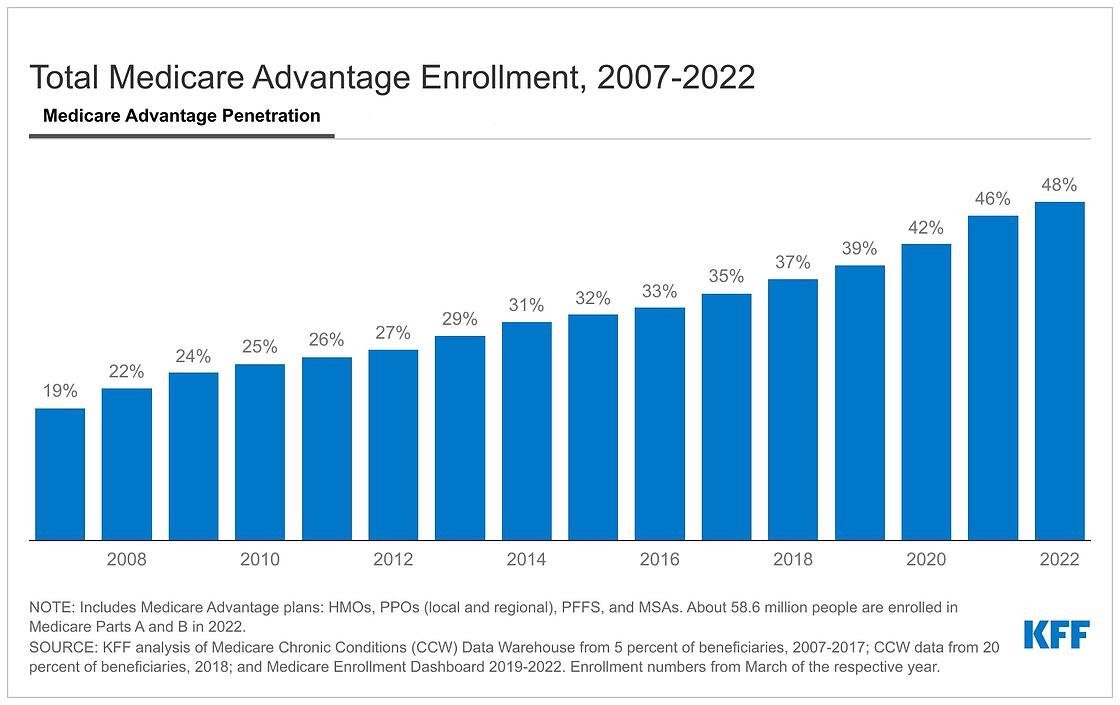
A new KFF analysis finds that nearly half of eligible Medicare beneficiaries – 28.4 million out of 58.6 million Medicare beneficiaries overall – are now enrolled in Medicare Advantage plans. That represents a more than doubling of the share of the eligible Medicare population enrolled in such plans from 2007 to 2022 (19% to 48%). Enrollment is projected to cross the 50 percent threshold as soon as next year, making Medicare Advantage the predominant way that Medicare beneficiaries with Parts A and B get their coverage and care.

Statutory and Plan-Bid Components of the Regional MA Benchmarks

Carriers set their actual prices by bidding against the capitation payment amounts. Carriers with plans that do well on Medicare Advantage program quality measures get a higher monthly capitation payment.

Statutory and Plan-Bid Components of the Regional MA Benchmarks

The annual election period for 2020 coverage is set to start Oct. 15 and run until Dec. 7. The capitation payment spreadsheet below shows about how much Medicare Advantage program managers think they should be paying each month for each Medicare Advantage plan enrollee’s care.

Carriers set their actual prices by bidding against the capitation payment amounts. Carriers with plans that do well on Medicare Advantage program quality measures get a higher monthly capitation payment.

  • The 2020 county-level averages range from $755 per month, in Presidio, Texas, up to $1,609, in Nome, Alaska.
  • To simplify things, we calculated state-level averages. The 2020 state-level averages ranged from $883 per month, in Hawaii, up to $1,168, in Alaska.
  • We also calculated how fast each state’s average capitation level changed between 2019 and 2020. The year-over-year change ranged from 4%, in Delaware, up to 8.2%, in one state.

ACCESS THE 2021 MEDICARE RATEBOOK: 2021 Medicare Ratebook (National, County Level Capitation Rates)

Determining Medicare payment for regional MA plans

Aside from a few special payment incentives, payment for regional MA plans is determined like payment for local plans, except that the benchmarks are calculated differently. CMS determines the benchmarks for the MA regional plans by using a more complicated formula that incorporates the plan bids. A region’s benchmark is a weighted average of the average county rate and the average plan bid.

As directed by law, CMS computes the average county rate as the individual county rates weighted by the number of Medicare beneficiaries who live in each county. The average plan bid is each plan’s bid weighted by each plan’s projected number of enrollees. CMS then combines the average county rate and the average bid into an overall average. In calculating the overall average, the average bid is weighted by the number of enrollees in all private plans across the country, and the average county rate is weighted by the number of all Medicare beneficiaries who remain in FFS Medicare.

#CMS #FFS Medicare #Medicare #2021RateBook

Title 42. Public HealthChapter IV. CENTERS FOR MEDICARE & MEDICAID SERVICES, DEPARTMENT OF HEALTH AND HUMAN SERVICES Subchapter B. MEDICARE PROGRAM Part 422. MEDICARE ADVANTAGE PROGRAM Subpart F. Submission of Bids, Premiums, and Related Information and Plan Approval Section 422.258. Calculation of benchmarks.