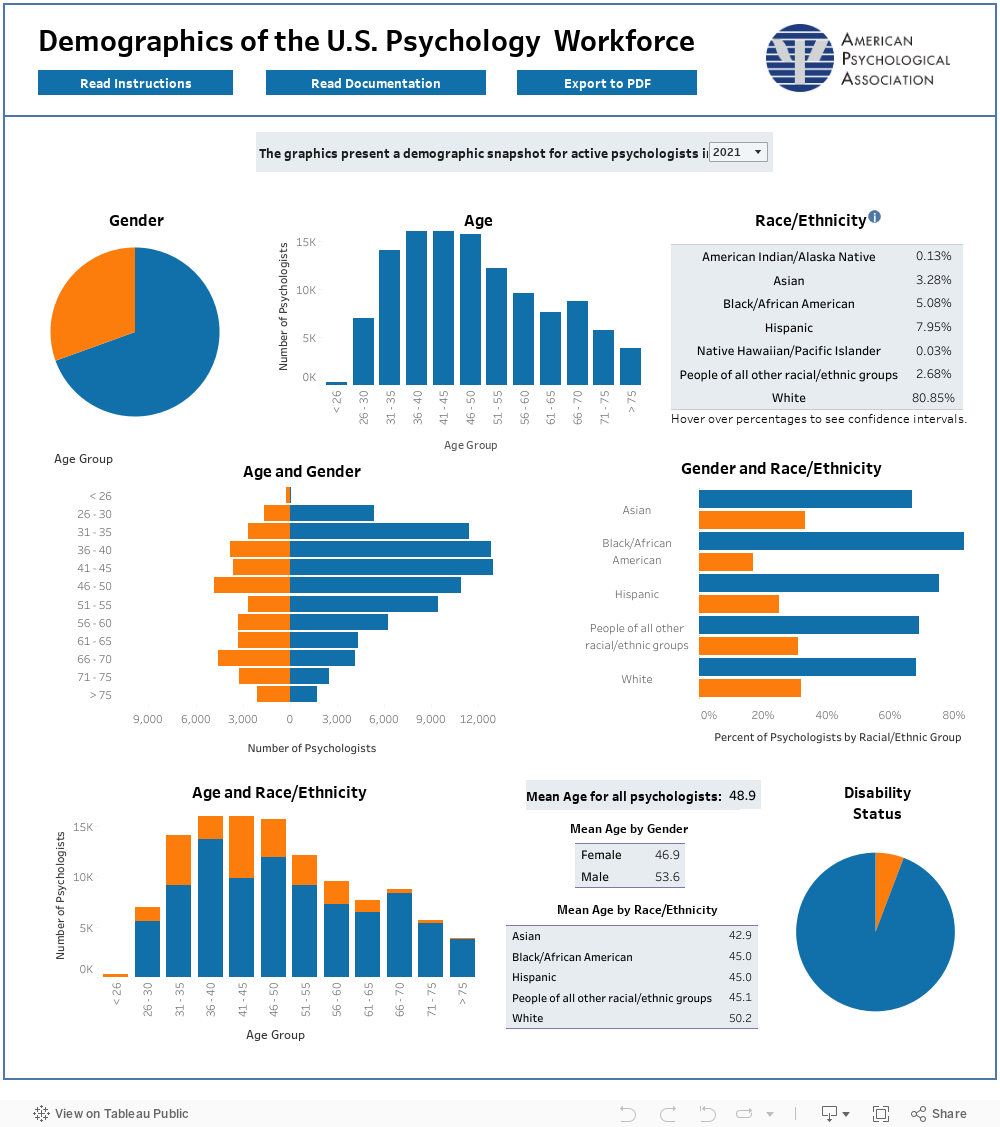
CWS Data Tool: Demographics of the U.S. Psychology Workforce

            <script type='text/javascript'>                    var divElement = document.getElementById('viz1608679702762');                    var vizElement = divElement.getElementsByTagName('object')[0];                    vizElement.style.width='1000px';vizElement.style.height='1927px';                    var scriptElement = document.createElement('script');                    scriptElement.src = 'https://public.tableau.com/javascripts/api/viz_v1.js';                    vizElement.parentNode.insertBefore(scriptElement, vizElement);                </script>

Learn to speak the Managed Care Language (101)

Healthcare flow of funds explained. Managed Care 101 for healthcare entrepreneurs seeking to do business in the California market. Session led by Alex Yarijanian, CEO Carenodes. The aim: providing healthcare entrepreneurs with a framework within which they will find their place in the business value chain.

Everyone should be able to walk out of this session feeling empowered by having learned the basic flow of funds (starting at the payer).

About this Event

Healthcare flow of funds explained. Managed Care 101 for healthcare entrepreneurs seeking to do business in the California market. Session led by Alex Yarijanian, CEO Carenodes. The aim: providing healthcare entrepreneurs with a framework within which they will find their place in the business value chain.

Topics covered in this session are as follows:

1. Managed Care Mind

  • Managed care: ‘utilization management’
  • Payment: Volume shift to value
  • Quality (‘value’) measured
  • Patient experience
  • Clinical outcomes

2. Lines of Business aka ‘LOB’ (funding source)

  • Medicare (Traditional Medicare and Medicare Advantage, Parts ABCD)
  • Medicaid (managed Medicaid, state / federal, Medi-Cal)
  • Duals (Medicare and Medicaid beneficiaries)
  • Commercial (on exchange, off exchange)

3. Products (benefit designs)

  • The spectrum of products: HMO, PPO, POS, EPO, FFS
  • Business ramifications

4. Difference between ‘LOB’ vs ‘product’

  • Difference between ‘LOB‘ (Medicare, commercial, etc) vs ‘product‘ (HMO, PPO, etc.)

The video and article link below is of an expanded version of this training https://www.carenodes.com/healthcare-flow-of-funds-explained-healthcare-entrepreneur-bootcamp/

Expert Seminar on Parity Laws and Reimbursement

Learn to speak the Managed Care Language (101)

Getting Paid (more) for Telehealth by Leveraging Mental Health Parity

About this Event

This is an advanced session for healthcare lawyers, general counsel, contracting VPs, C-suite, consultants.

Healthcare providers and technology companies looking to launch a new telemedicine or mHealth program may find an unexpected ally in commercial health plans. Healthcare providers looking to launch a new telemedicine or mHealth program may find an unexpected ally in commercial health plans. But they need to understand how and what mechanisms to trigger. For example, in mental health, most fail since they are unaware of mental health parity leverage points.

A Carenodes Network provider noted that one private payer in Mississippi won’t cover telehealth even though it’s mandated by the state, and another one of our providers said health plans in New York have found a way to reimburse for telehealth at only half the rate of in-person coverage.

We will discuss these cases, outcomes, and how we managed to obtain better reimbursement terms and partnerships — substantially improving client position and patient access.

This method has demonstrated an average of 46% increase in topline payer reimbursement for healthcare providers.

RELATED FREE CONTENT (ON DEMAND)

For those seeking to learn more about practical tools from payer executives, see Mental Health Parity: Provider Guidance Session and Q/A with Payer Executive https://www.youtube.com/watch?v=E5pG319Wd7o&t=323s

Chris Esguerra, MD and Alex Yarijanian address mental health parity and what providers can do to hold health plans accountable. These two executives provide tools/tips/resources behavioral healthcare providers and startups can use to hold payers accountable to equitable access to mental healthcare.

https://www.eventbrite.com/static/widgets/eb_widgets.js var exampleCallback = function() { console.log(‘Order complete!’); }; window.EBWidgets.createWidget({ // Required widgetType: ‘checkout’, eventId: ‘132115558191’, iframeContainerId: ‘eventbrite-widget-container-132115558191’, // Optional iframeContainerHeight: 425, // Widget height in pixels. Defaults to a minimum of 425px if not provided onOrderComplete: exampleCallback // Method called when an order has successfully completed });

Online Events,Online Seminars,Online Health Seminars, mentalhealth, #mental_health_training#healthcare_lawyers#carenodes

Provider – Contracting: KPIs

KPI / MetricFormula or DefinitionTargetBusiness Purpose
Gross RevenueGross Revenue or “Top Line Revenue” is synonymous with gross charges associated with the provision of servicesThis is Facility Specific. GR is budgeted at the Financial Class Level based upon historical payer mixes, demographic studies, material managed care contracting changes and other forecasting methods.From a revenue cycle management perspective, the objective is rapid, compliant conversion of Gross Revenue into Cash (and legitimate associated contractual adjustments) Therefore, GR is a significant input in a number of relevant KPI’s.
Net RevenueThe term Net Revenue has diverse definitions within the industry but is best defined as: The value of the hospitals dollar, less contractuals, less bad debt.Different methods are used to determine both the value of the Active AR and related %’s that are applied to Gross Revenue to determine its Net Revenue.This is Facility Specific. The NR target is based upon reducing Gross Revenue by anticipated contractual allowances and a Bad Debt Expense target.The contractual allowances and BD%’s are applied by a combination of a calculated model and/or history.A primary objective of the Revenue Cycle Team is to increase Net Revenue through denial prevention and recovery as the reduction of the Bad Debt Expense through improved Self Pay receivable management strategies.
Net Patient Revenue(Before Bad Debt)Net Patient Revenue is Net Revenue prior to making deductions for Bad debt Expense and could be defined as “Maximum Net Collectible Value”Same approach as Net Revenue.Measure Cash as a % of Net Patient Revenue instead of Cash as a % Net Revenue. This approach is not as common as Net Revenue.
Lag Revenue(Rolling 2,4,6 months)Most Gross Revenue is converted into cash and associated contractual adjustments with in 45-60 days. As a result, cash targets are based upon a prior month’s revenue or a rolling average of a prior periods revenue. This is referred to as Lag Revenue. Some targets are based upon a 2 month average with a one month lag.N/ALag Revenue is constantly studied, normalized and modeled to help the hospital become increasingly scientific in setting cash and contractual allowance targets.
Modeled Net Revenue (%)(Expected Reimbursement)Net Revenue Modeling is the practice of converting contract terms(and for Government Payers; DRG and APC Driven reimbursement) into an Expected Reimbursement calculation at the account level. From there, projections can be made based upon “perfection” (not considering denials and underpayments, etc.) from a Reimbursement standpoint. Modeled Net Revenue is usually expressed as a %.This is Facility and contract specific.This works if you Net most of the Receivables at the time of Final Billing. Many facilities utilize historical experience for Net Revenue and related contractuals
Experiential Net Revenue % (ENR) Zero Balance accounts for 12-18 monthsExperiential Net Revenue (ENR) is best described as Collections against the dollar on a large sample of zero balance accounts.The Formula is Receipts/Charges 12-18 months of zero balance charges. Often expressed as a %ENR should be as close the the MNR as possible. The Delta between ENR and MNR is the economic opportunity.ENR% is used to calculate cash target, average daily net revenue and is an input for a host of other critical Key Performance Indicators
Average Daily Gross Revenue6 months gross revenue/ total number of days in the calculation period. Expressed as a $ amount.There may be seasonality to consider so 6 months may be a better standard to determine average daily gross revenue. (Industry standards are 3 months)ADGR is the divisor for a number of other KPI’s. It is conversational language for “how much Business” is being generated on a daily basis.
Average Daily Net Revenue6 Months net revenue / total number of days in the calculation period. Expressed as a $ amount.There may be seasonality to consider so 6 months may be a better standard to determine average daily net revenue. (Industry standards are 3 months)ADNR is the divisor for a number of other KPI’s. It is conversational language for “how much Business” is being generated on a daily basis.
Cash as % of Net RevenueCash/Lag net Revenue (Or Net patient Revenue). Expressed as a %100% or GreaterThis is the most important of all KPI’s and measures cash performance against opportunity for cash performance. This KPI increases in value when calculated at the Financial Class Level and allows for team by team organizational goal alignment.
Bad Debt as % of Gross Revenue(Bad Debt Transfers – Bad Debt Recoveries) / Gross Revenue. Expressed as a % and $ amount.This is NOT the finance view of Bad Debt Expense (which is out of scope for this document but includes looking at actual BD write offs Less recoveries against the budgeted BD allowance against the value of the Self Pay Receivable)From the Revenue Cycle Perspective, this calculation should be managed daily and if at 3.1% or less, will equate to successful migration of Bad Debt Risk. (% is client specific)Used to measure the effectiveness of both Front End Financial Securement and Self Pay follow up.It is critical that only qualifying accounts be referred to BD and that the provider continuously look to reallocate High Risk Self Pay to Federal, State, Private and Local or other funding sources.
Charity Care as a % of Gross RevenueCharity Care Write offs/Gross Revenue. Expressed as a % and $ amounts.Finance, using primarily volumes and experience, prepares a charity budget.From a Revenue cycle Perspective, charity care write-offs are targeted at 1.9% of Gross Revenue. (% is client specific)Charity Care is described as the inability to pay for services rendered (whereas Bad Debt is based upon unwillingness to pay)Non Profits maintain their standing through the provision of Community Benefits visa vie Charity Care.Therefore, it is imperative that qualifying Charity Care accounts not be wrongly classified or through fractured process flow to bad debt.
DNFB – Discharged Not Final BilledDNFB is a term used to define unbilled accounts where the patient has been discharged (for outpatient services the admit and discharge date is one and the same) and the account is either not coded, or pending charges, service documentation or claim holds to be released into the final billed receivable.The Formula for calculating the DNFB target is:ADGR x 4 (4 is an example) … Expressed as $DNFB Targets are financial class and patient type specific.Example: if your suspense days is 4 for Non Government payers then: 4 X ADGR would be your calculation…If you have a 5 day suspense for Government payers then you would calculate this as: 5 X ADGR for Gov. PayersIt is critical to success that the DNFB be managed and sustained with the targeted range as that with is not coded/released cannot be converted to cash.
Unbilled beyond SuspenseWith in the DNFB receivable is a subset of accounts that have moved beyond the targeted date (which is called the Suspense Cutoff date). These receivables represent a direct delay in cash conversion opportunity.The target for this calculation, whether expressed as Days, Net Days or $ is ZEROUnbilled beyond Suspense receives high attention from all functional areas within the revenue cycle, tends to represent the exact co-efficient of any cash short fall being expressed during the month.
DNFB DaysDNFB Receivable Outstanding / Average Daily Gross Revenue (Or Net DNFB Receivable Outstanding / Average Daily net revenue)Fin Class specific, usually 3-5 daysAlso calculated as Net DNFB daysSee above
Gross Days In Revenue OutstandingActive accounts receivable outstanding / Average daily Gross RevenueCalculations can vary: Gross Days Target at the Financial Class level and then aggregates the total for a more specific (and less anecdotal) approach to managing days.This KPI is in the top 5 and is a strong “processing KPI” but may not be tied directly to cash performance. (Avoidable write – offs and high bad debt may produce lower AR days while cash performance is at a variance to target.
Net Days in Revenue OutstandingActive Accounts Receivable / Average Daily Net RevenueCalculations can vary: Net days target at the financial class level and then aggregates the total for more specific approach to managing daysSee above
Days Lower Control LimitA term used to describe absolute perfection for A/R Days at the Financial Class (and the aggregate) level. For Example, a perfect Medicare Inpatient Claim is Inhouse for 3.2 Days, DNFB for 5 days and the submitted and adjudicated in 14-16 days.Financial Class SpecificDays LCL, for both Net and Gross, is an input used for several targets and KPI’s within the Revenue cycle.
Held Claims DaysClaim submission date – Final Billed Date expressed as # of calendar days.No claim should be held longer than 1 business day for correction and submission/re-submission.This is a standard Claims Management KPI that seeks to place rigid controls on predictable, regular billing porduct in CBO.
Clean Claim RateClean Claims/Total Claims expressed as a %95-98%This is a standard Claims Management KPI that seeks to place rigid controls on predictable, regular billing product in CBO
ErosionAs accounts get older, then become less collectible – or “erode” on the Accounts Receivable.
1. A/R > 90Creditors that loan hospitals money against their A/R asset use A/R > 90 as a critical measure of the health of the accounts receivableThrough the use of Days Lower Control Limitis, Financial class specific targets can be set around tolerable volumes of accounts moving past 90 Days.Must maintain acceptable targets from an aging perspective to ensure strong cash performance, and avoid Finance “devaluing” the Active A/R based upon volumes moving into this aging category.
2. A/R > 120Self pay accounts may be deemed worthless (either in A/R or Bad Debt) after valid collection effors for 120 days.Financial Class Specific and is dependent upon whether SP after Insurance is blended with pure Self Pay.120 is an important trigger for Mediare Cost Report compliance and set the standard for Bad Debt Transfers on account that are validated to be uncollectible
POS CashCash collected at, or as a direct result of front end functional area efforts (such as Financial Counseling)Targeting for POS Cash becomes meaningful when measured against an estimated patient portion due.Initiative to implement a Patient Payment Estimator.POS Cash Management is critical because the psychological opportunity to collect declines rapidly after the Patient leaves.There is a direct correlation between POS Cash performance and bad debt reduction.
POS Cash as % of Self Pay Cash CollectedThis Metric measures the overall composition of Self Pay Cash Performance and seeks to understand the contribution of POS Cash Management to the Overall Self pay campaign.See AboveSee above
Percentage of Receivable over 120 DaysPercentage of current total receivables, as defined by amounts owed to the provider/facility by patients, third party payers etc. that is greater than 120 days post dischargeFind this data in your Aged Trial BalanceBenchmarks:
Best practice less than 12%
Average between 12 and 25%
Alarm Greater than 25%
% business in VBC

Carenodes Behavioral Health Case Management

ETHOS AND PROGRAM DESIGN

The central premise of the Carenodes Behavioral Health Case Management (BHCM) Program is to promote collaboration between all treating providers, ensuring coordination between medical care and behavioral health care. Once members are identified, Behavioral Health Care Managers outreach / consult with our community partners in medical and behavioral health practice settings. Our program supports the treatment planning needs of providers with respect to behavioral health services and often provides consultation/ suggestions for modifications in current care. This coordination is performed through various avenues including

  • Notification letters to physicians informing them that their patients are engaged with the program,
  • Telephonic outreach calls,
  • Opportunity/option for physician peer-to-peer consultation when needed.

The essence of behavioral health management is ensuring that we direct our members to the right services at the right time.

Our triage and tracking processes include specialized support during service level transitions, such as a discharge from inpatient to outpatient follow-up treatment to ensure that members are attending follow up appointments with community providers within 7 days of hospital discharge. In addition, we utilize a readmission risk algorithm, which identifies members most at risk for readmission to inpatient hospital care. Specialty services are also offered to members diagnosed with eating disorders, maternal mental health issues, families of children and adolescents with a recent inpatient psychiatric stay, and members referred from community providers affiliated with Enhanced Personal Health Care. Also, consenting members engaged in medical care management programs with a positive PHQ2 depression screen or any other BH condition impeding the member’s ability to manage their medical condition are routed to BH for intervention.

Clinical Team/Patient/Family Engagement

Our clinicians work with the member and their family to:

  • Understand the options available for behavioral health treatment, utilize insurance benefits for the lowest possible out of pocket cost, and decrease unnecessary health care expenditures
  • Advocate for the coordination of all care, both medical and behavioral health
  • Educate on symptoms and condition management to prevent future inpatient hospitalization stays
  • Discuss and identify barriers to treatment compliance and offer resources and support to overcome them
  • Improve overall health outcomes for improved quality of life

Effect of Care Coordination on Patients With Alzheimer Disease and Their Caregivers | AJMC

Although care coordination did not decrease overall acute health services use, coordination improved clinical documentation of patients’ memory impairment. ED visits may have begun to decrease among patients. Finally, stress levels may have fallen among caregivers.

Conclusions: Although care coordination did not decrease overall acute health services use, coordination improved clinical documentation of patients’ memory impairment. ED visits may have begun to decrease among patients. Finally, stress levels may have fallen among caregivers.

Effect of Care Coordination on Patients With Alzheimer Disease and Their Caregivers
November 3, 2020
Brian Chen, JD, PhD , Xi Cheng, MPH , Blaiz Streetman-Loy, PhD, MSW , Matthew F. Hudson, PhD, MPH , Dakshu Jindal, MA , Nicole Hair, PhD
Volume 26, Issue 11

Takeaway Points

Care coordination and caregiver support remain the primary intervention to meet the growing challenge of caring for patients with Alzheimer disease and related dementias (ADRD). Few studies, however, assessed their impact on objective measures of health care utilization. We studied patients and caregivers enrolled in the Memory Program in Greenville, South Carolina, and found strong evidence that the program led to better documentation of patients’ AD diagnosis. We also found evidence suggestive of a reduction in emergency department (ED) utilization among patients with AD and a potential reduction in urgent medical utilization for depression among caregivers.

  • Existing literature on ADRD interventions often focused on feasibility and self-reported outcomes.
  • Our studies assessed the impact of the Memory Program on objective measures of health care utilization for patients with AD.
  • The immediate impact may be better clinical documentation of AD even when patients seek care for other medical conditions.
  • There is suggestive evidence that the intervention reduced ED utilization among patients and acute medical service use for depressive symptoms among caregivers.

Read more

Statutory and Plan-Bid Components of the Regional MA Benchmarks

Carriers set their actual prices by bidding against the capitation payment amounts. Carriers with plans that do well on Medicare Advantage program quality measures get a higher monthly capitation payment.

Statutory and Plan-Bid Components of the Regional MA Benchmarks

The annual election period for 2020 coverage is set to start Oct. 15 and run until Dec. 7. The capitation payment spreadsheet below shows about how much Medicare Advantage program managers think they should be paying each month for each Medicare Advantage plan enrollee’s care.

Carriers set their actual prices by bidding against the capitation payment amounts. Carriers with plans that do well on Medicare Advantage program quality measures get a higher monthly capitation payment.

  • The 2020 county-level averages range from $755 per month, in Presidio, Texas, up to $1,609, in Nome, Alaska.
  • To simplify things, we calculated state-level averages. The 2020 state-level averages ranged from $883 per month, in Hawaii, up to $1,168, in Alaska.
  • We also calculated how fast each state’s average capitation level changed between 2019 and 2020. The year-over-year change ranged from 4%, in Delaware, up to 8.2%, in one state.

ACCESS THE 2021 MEDICARE RATEBOOK: 2021 Medicare Ratebook (National, County Level Capitation Rates)

Determining Medicare payment for regional MA plans

Aside from a few special payment incentives, payment for regional MA plans is determined like payment for local plans, except that the benchmarks are calculated differently. CMS determines the benchmarks for the MA regional plans by using a more complicated formula that incorporates the plan bids. A region’s benchmark is a weighted average of the average county rate and the average plan bid.

As directed by law, CMS computes the average county rate as the individual county rates weighted by the number of Medicare beneficiaries who live in each county. The average plan bid is each plan’s bid weighted by each plan’s projected number of enrollees. CMS then combines the average county rate and the average bid into an overall average. In calculating the overall average, the average bid is weighted by the number of enrollees in all private plans across the country, and the average county rate is weighted by the number of all Medicare beneficiaries who remain in FFS Medicare.

#CMS #FFS Medicare #Medicare #2021RateBook

Title 42. Public HealthChapter IV. CENTERS FOR MEDICARE & MEDICAID SERVICES, DEPARTMENT OF HEALTH AND HUMAN SERVICES Subchapter B. MEDICARE PROGRAM Part 422. MEDICARE ADVANTAGE PROGRAM Subpart F. Submission of Bids, Premiums, and Related Information and Plan Approval Section 422.258. Calculation of benchmarks.

Sample Letter: Enlisting Patients Assistance for Claims Payment

Enlisting patient assistance in health insurance claims payment issues.

Date

_____________
_____________
_____________
_____________

RE: Outstanding Health Insurance Payment  

Dear Patient:

I am writing you concerning an issue that has arisen between [ patient’s insurance carrier ] and our office concerning payment for the services provided to you on [ date of service ].”   We have made all reasonable attempts to collect from your insurance company and have not been successful.

PATIENT MESSAGING


[Explain the reason the plan has given for not paying you, or not paying you on time. Stick to the facts. Tell the patient you’re puzzled by the plan’s contention, and that you would appreciate their help in resolving any issues. If the plan’s policy is that the patient is ultimately responsible for the full cost of care, state that.]


We would appreciate your assistance in resolving this matter by:

  • Calling your insurance company directly and asking that the claim in question be paid immediately; and,
  • By asking your employer’s human resources staff to intervene.

Should you or your employer have any questions, please do not hesitate to contact our office at [practice contact and telephone number].

Thank you very much for your assistance and we appreciate your continued business.

Sincerely,

c: [ Name of Insurance Carrier ]